Wednesday, April 16, 2008

Together For The Gospel 2008: Session #4


Mark Dever

Improving the Gospel: Exercises in Unbiblical Theology

People try to improve the gospel. But in improving the gospel they end up losing it. Some Corinthians wanted to add human wisdom and eloquence. Some Galatians wanted to add observance of the ceremonial laws of Moses. Some Colossians were adding everything from worldly philosophy to the worship of angels.

Before we can know what is being added to the gospel, we need to know what the gospel is. Study the New Testament to learn what the gospel truly is, what it consists of.

God is fundamental to the gospel. Our creation in His image and our fall are fundamental. Christ’s incarnation, perfect life, death, and resurrection are fundamental. And this instruction is not merely an application but part of the gospel message itself. We must clearly define the gospel.

What attempted improvements can we see today? What are the threats that we face as we defend the gospel as it is revealed in the New Testament?

5 cries that try to improve the gospel:

1) Make the gospel public
Jesus came to save the structures of society. This cry believes that we will see more of the fullness of the kingdom of God here in this life than Scripture would seem to imply. Seeing societies, politics, government and such reformed is the purpose of the gospel proclamation and saving work and not just an effect.

The gospel is a uniquely Christian message and has been uniquely entrusted to the Church. Non-Christians will join us in the pursuit of reforming society but they will NOT join us in the propagation of the gospel and the exaltation of Jesus Christ as King of kings and Lord of lords.

  • Acts 8:12, 14 - The message of the kingdom of God is associated with baptism in Christ’s name and the reception of the Word of God.

Non-Christianss, therefore, are not doing kingdom work though they may be doing things that Christians ought to be doing.

Never substitute good works for the preaching of the gospel.

2) Make the gospel larger
Did Jesus come really only to save our souls? This cry thinks through a Christian worldview, which we should be doing. But implications of the gospel are sometimes referred to as part of the gospel.

Is the gospel more than believing that our faith in Jesus Christ saves us from the wrath of God?

The gospel is not a collection of moral positions or actions. This is fruit that grows from a life that has been transformed by the gospel.We must distinguish between the core of the gospel and its implications. We must clearly define what a person must fundamentally believe in order to be rightly called a Christian.

  • 1 Thessalonians 2:8 - Sharing the gospel is more than just sharing our lives with others.

Does the gospel include opposition to abortion or working to end unjust laws? If so, then it must include ending the war in Iraq and nationalized health care and much, much more.

The unavoidable path we end up going down is that when we make the gospel larger than what it really is, it will be hard to see those who don’t agree with us to truly be Christians because they surely have gotten the gospel wrong since they’ve gotten abortion wrong (or whatever other issue we claim to be an indispensable part of our Christian worldview).

Don’t confuse the gospel with a Christian worldview.

3) Make the gospel relevant
How will people be saved? This cry says we must contextualize. The gospel appears irrelevant to people today so we must change our message by becoming all things to all men. We must figure out what keeps non-Christians from coming to hear the gospel and then adapting so that they will want to come.

A concern for evangelism, sadly, has often been the path to theological liberalism. In order to reach the lost, we do whatever works and end up abandoning, whether knowingly or not, core truths about God and His ways with man.

We must do away with the idea that we should adapt our methods to “studies have shown…”

If this is true, then what happens when the atheists, and Mormons, and Muslims, figure out how to be more relevant than we are? Then what do we do?

Embracing relevance attracts a certain kind of people. This leads to a homogeneous congregation when our goal is a heterogeneous congregation.

Yes, we should contextualize in the sense that we take the gospel into different places by going physically and being willing to lay aside our own comforts and conveniences. Contextualization should never make the gospel more acceptable or less offensive. If we have communicated the gospel faithfully, it should only make the offense more clearly. We must always have a distinction that bears witness to the reality of the gospel. The gospel’s relevance appears precisely in our being distinct.

4) Make the gospel personal
Are we saved alone as individuals apart from the local church? What is God about in Jesus Christ?

  • Ephesians 3:10 -The manifold wisdom of God is to be made known through the church.

Our participation in the local church validates or falsifies our witness for the gospel. The reason we have gifts is not just for ourselves and our own purposes but to serve a local congregation. Many Christians see the gospel as that which saves them individually and not that which brings them into a body of fellowship, except when it is convenient. The idea of being committed to one congregation and serving primarily in that context is utterly alien. Many assume that the church is just a plural word for Christian.

A wrongly personalized gospel ends up with a wrongly personalized church. Being vague about our understanding of the church can hurt our understanding and communication of the gospel. Two or three gathered in Jesus’ name are not necessarily a church.

Wrong ideas of the church encourage wrong ideas about the gospel. The audible gospel is intended to be displayed by the visible church comprised of individual people who may have very little in common apart from this gospel that brings them together. The church isn’t just a collection of individual lights. The church is a furnace that is meant to burn brightly and makes other lights.

Don’t decouple the gospel by decoupling it from the local church.

5) Make the gospel kinder
Why does God save us? This cry says that the ultimate purpose of the gospel is the greatest good for the greatest number of people. God’s highest desire is to rescue the greatest number of people from hell that we can. The ultimate purpose of the gospel is the salvation of sinners.

God’s ultimate purpose is not seeing the most sinners saved but about getting the most glory for Himself.

  • 1 Thess. 1:2, 3 - God gets the thanks and the glory in our salvation. This is the goal.

All that exists is for God’s own pleasure in the display of His manifold perfections.

  • Romans 9:22, 23 - Our churches are a demonstration of God’s character and His mercy.

Look at Ezekiel. God does all that He does so that His people will know that He is the LORD. Look at Exodus. God does all that He does to demonstrate His great power.

We should want to see people saved and for their own good, but even more for God’s great glory so that the truth of our Creator will be known, so that He will be loved and worshiped.

To add to the gospel is always to remove from it and to detract from God’s glory.

So the message is simply this: keep the message clear and don’t add anything to the gospel.

Download the audio here.
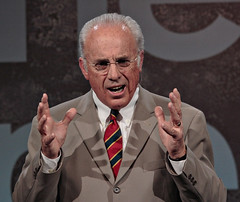
Together For The Gospel 2008: Session #3


John MacArthur

The Sinner Neither Able nor Willing: The Doctrine of Absolute Inability

John 5:39 40 - Even those who know the Scriptures are unwilling to come to Jesus for eternal life.

John 6:44 - No one can come to Jesus unless drawn by the Father. We are all unable.

The doctrine of total depravity is the most hated doctrine of Christianity. Every other religion except for Christianity is a works-based system that says that man has enough goodness in him to contribute to his salvation. This doctrine is most minimized when it should be most maximized, especially in the Church.

This is the most God-honoring doctrine, honoring God completely and leaving no honor for man because it makes salvation entirely a divine work.

This is the most historical doctrine despite free-willers who seem to think otherwise, dating back to the early battles between Augustine and Pelagius. Total depravity is the foundation of all anthropology and all soteriology.

How does the Bible speak of this doctrine of total depravity?

It typically speaks of this condition as being in a state of death.

  • Ephesians 2
    • v.2: We are dead in trespasses and sins.
    • v.3: The phrase “by nature” means “by birth.” This is how we are born because of the sin of Adam.
    • v.4: If anything is to change this, it is the grace of God and that’s why Paul makes the transition in here to highlighting the mercy and grace of God.
  • Ephesians 4:18 - We are darkened in our understanding, excluded from the life of God.
  • Colossians 2:13 - God makes us alive by commanding us to live just like Jesus commanded Lazarus to rise from the dead (John 11).
  • John 1:12 - We must be born of the will of God, not man.
  • John 3:6-8 - Being born again is a divine work because flesh can only produce flesh. And the Holy Spirit who alone gives life is sovereign in determining whom He will give life to.
  • John 5:21 - The Son gives life to whom He wills.
  • John 6:44 - The Father is the only One who can draw.
  • John 8:36 - The Son shall make free.

This is the sovereign work of the triune God.

  • Romans 8:7, 8 - The sinner is not only unwilling to acknowledge the triune God, he is unable to acknowledge the power of the gospel.
  • 1 Corinthians 2:14 - The natural man is unable to understand the things of God
  • 2 Corinthians 4:4 - There is a compounded blindness, blindness in original sin and blindness by Satan, the god of this world.
  • Mark 7:20-22 - What does man produce? Evil only.
  • Romans 3:9-18 - There is none righteous. No ability, no hope on our own.

To say one is totally depraved means that he can only sin and can do nothing to please God. It affects him totally: mind, thoughts, will, desires, affections.

The contemporary idea is that there is a residual good left in the sinner. There is something in the sinner that can respond. And the sinner must make the first move.

But the Bible teaches that he has no capacity and no interest to make the first move. To tell a sinner that God will give him his desires if he comes to Him is destructive because it feeds his inclination to evil.

To lead people to rely on their own goodness is deception of the worst kind and to lead them to rely on religion is blasphemy of the worst kind.

  • 2 Timothy 2:25 - God must grant repentance.
  • Titus 3:3, 4 - When found in our wickedness, God saves us according to His kindness.

What are the implications of embracing this doctrine?

1) We will know that Jesus means for us to more than just care for the poor and needy. A hungry and homeless person's greatest need isn't to have a roof over his head and food in his stomach, as important as these things are. His greatest need is to be raised from the dead if he hasn't been.

2) We will know that our methods don’t need to change to accommodate the sinner.

Soft preaching makes hard people. To preach soft truth hardens hearts. To preach hard truths breaks hard hearts.

3) We will know that our message is not to change.

The reality is not on the outside but rather on the inside. All hearts are the same. All need the same message, the same gospel. So our context doesn’t matter. It doesn’t matter where in the world you are. MacArthur noted how in his extensive ministry traveling all around the world, through translators and all, there has been the same response to the gospel. Some repent and some are hardened.

Be meek and humble. No one should be so meek and humble as those who preach the gospel. We are the only profession in the world where we can take absolutely no credit for what we do. We can only take credit for our failures, never our successes. We are just clay pots.

One might ask: Aren’t we supposed to adjust like Paul (1 Corinthians 9:19-23)? Paul didn’t say "I change my message, my method, my clothes, or my vocabulary." He said that he himself changed, making sacrifices to reach as many as possible.

It’s not about how cool or relevant we are. It’s about how clear we are.

Download the audio here.

Together For The Gospel 2008: Session #2


Thabiti Anyabwile

Bearing The Image: Identity, The Work of Christ, and The Church

Thabiti began by telling us that the vast majority of us are living our lives with a wrong assumption that needs to be corrected.

That assumption is this: that there exists such a thing as race. If our standard of truth is the Bible, then the concept of race is as much a figment of our imagination as unicorns.

This requires a definition of terms. When Thabiti speaks of race, he is speaking of the idea that traces the distinction in people groups to biological differences, something different in our DNA. Ethnicity, he claims, is an entirely different concept. Ethnicity is that which traces our distinction in people groups to things such as region, language, and culture. And this is all based on the fact that the Bible teaches that all human beings descend from one man, Adam. Biblically speaking, race does not exist. Only ethnicity.

Many people often point to Genesis 10 and the account of the Tower of Babel as the origin of race by emphasizing the discontinuity among people groups that stems from the divergence of the generations of the sons of Noah. However, Thabiti pointed out that the chapter is bookended by the continuity that shows that these generations all come from one man. This adds to the Scriptural evidence (Genesis 3:20 and Acts 17:26) that we are not biologically different.

He structured his talk with a baseball analogy. He would move from first base to home plate:

First base: our union in Adam. (all people)
Second base: our union in Christ. (from this point on, Christians only)
Third base: our union in the Church.
Home plate: our union in glory.

Everyone, Christians and non-Christians alike, are related in Adam. Our relation in Adam, other than our all having fallen into sin through him, is in two ways:

1) We are all physical descendants of Adam

2) We are all created in the image of God like Adam

This means that there can be no biological difference that we call race. To embrace the idea of race is dangerous for at least six reasons:

1) It lends to abuse of people and Scripture

2) The distance from embracing race to embracing racism is a short distance

3) It undermines our ability to engage with other people

4) It undermines the authority and sufficiency of Scripture

5) It undermines the work of the Holy Spirit

6) It undermines the Gospel

When we operate under the notion of race, we become those who walk into a room full of people and define those who are like us to be those who look like us. In reality, we should walk into a room full of people and define those who are like us to be those who are descendants of Adam and those who are created in the image of God. That’s everyone.

Up until now, we are talking about all people, whether Christian or non-Christian. But when we get into the realm of only believers then with those who are like us there is an even greater tie. Those who are like us are not just those who descend from Adam and those who are created in the image of God, but this includes those who are in Christ, bought with the blood of the Lamb. Paraphrasing Sinclair Ferguson, our union in the blood of Christ is one that far surpasses any DNA match.

The part that I was struck by most was when Thabiti talked about how we are missing the point when we talk about having a focus on racial reconciliation, a reconciliation that majors on entering into other people’s racial experiences and embracing them for who they are in order to have a greater unity in Christ. When we do this, we are getting it backwards. Instead, we are to focus on our union in Christ as those who have been bought and washed and justified and sanctified and this will form the greatest basis by which we will be able to embrace each other as different as we may be. We shouldn't spend all our time looking at each other. But we should spend all our time together looking at Christ, beholding His person and work. This is what gives Christ glory.

The showcase by which we display this group of reconciled people is the church. And this is third base, after we have realized our unity in Christ (second base). And the church is an earthly representation that is only a taste and partial experience of what will be fully realized when Christ comes to wrap-up redemption and bring us to home plate, our union in glory where, gathered around the throne of the Lamb will be worshipers from every tribe, tongue, and nation.

Listen to this message. It is challenging and much needed for the church today. Earlier in the day, I met an African-American brother that told me he had seen me at another conference. He said that he had walked past me at that conference and said the word seven because he had only counted seven of "us" at that particular conference. By "us", he meant black people. Listening to this talk made me think that though there might be room for talk like this outside of the church, there shouldn't be inside where "us" should only represent those of us who were once far off but have now been brought near by the blood of Christ (Ephesians 2:13). It made me think about why I'm more inclined to call a black man brother than a white man even though the black man might be an enemy of Christ and the white man my true brother in Christ.

Lord, please continue to sanctify me by the power of Your Holy Spirit so that I no longer regard anyone from a worldly point of view as I still in many ways do. Thank You for Your patience and mercy in Christ. In His precious name, Amen.

Download the audio here.

And watch this clip to whet your appetite (HT: IndyChristian, Challies):

Together For The Gospel 2008: Session #1


Ligon Duncan

Sound Doctrine – Essential to Faithful Pastoral Ministry: A Joyful Defense and Declaration of the Necessity and Practicality of Systematic Theology for the Life of the Church

Systematic theology answers the question: “What does the entire Bible teach us about ______?”

More specifically, a doctrine (or teaching) answers the question: “What does the entire Bible teach us about _(some topic)_?”

And systematic theology is a collection of all the doctrines to be gathered from the Bible.

Scriptures that point us directly to the importance of theology:

  • John 17:13-17 - Jesus teaches that theology is the source of our joy and, not only this, it is the source of our growth.
  • Matthew 28:18-20 - Jesus wants us to teach everything he commanded, not just the ABC’s
  • 1 Timothy 1:3 - Paul’s first instruction to Timothy is to tell teachers not to teach bad theology
  • 1 Timothy 1:10 - We know how we are to behave based on proper theology.
  • 1 Timothy 6:1-3 - Proper theology leads to godliness.
  • Titus1:1
  • Knowledge of the truth (theology) leads to godliness.

According to the Puritan William Perkins, theology is simply the science of how to live blessedly ever after. And, therefore, everyone is a theologian in some sense, whether they know it or not. The question is whether you are a good theologian or a bad theologian. The question is whether your theology is right or wrong.

Three main points:

1) Theology is criticized in the church today, even among evangelicals

    • Use more stories and narrative because people in this generation connect with storytelling more than teaching
2) The Bible teaches systematic theology

    • Luke 24:27 – when Christ teaches the disciples from all the Scriptures about the things concerning himself, what is he doing? Systematic theology! He is answering the question “What does the entire Bible have to teach about ME?” In other words, He’s teaching them Christology, the doctrine of the person and work of the Messiah.
    • Acts 18:28 – Apollos does the same thing in Ephesus, showing from all the Scriptures that Jesus is the Christ
    • Acts 17:3 – Paul does the same thing in Thessalonica, showing from all the Scriptures that Jesus is the Christ
3) What is theology important for?

    • It leads to worship. Look at Romans 11:32-36. Verse 32 is doctrine, a point of theology. And what does it directly lead to in verses 33-36? Doxology! Praise to God!
    • It is important for assurance in the life of the Christian. When Jesus tells his disciples in John 15:16 that he chose them, this is precious because they are all going to abandon him in just a matter of hours. Only the doctrine of sovereign election can give them (and us) the confidence that we are not hopeless and utterly forsaken when we fail Christ.
    • It is important for marriage. This one was most powerful for me as I’ve been thinking about this very thing over recent months. When Paul tells husbands in Ephesians 5:25 to love their wives as Christ loved the Church and gave Himself up for her, he is telling them to look at the doctrine of atonement treasure its absolute sufficiency and supremacy in justification and making them right with God. But after this, he is telling to look at the doctrine of the atonement and let that teach them how to love their wives. The implications for this, to me, are stunningly beyond words.

One of the major thrusts in some evangelical circles is to favor biblical theology (narrative/story of redemption) over systematic theology. In the panel discussion following this sermon, Lig and the guys did a great job clarifying how biblical theology and systematic theology, when done properly, are never divorced from each other. And one of the great points that Lig made was that when Jesus told parables and stories, His point wasn’t to make the truth fuzzy. But rather His point was always to convey a point of truth made razor sharp through a story that would drive it into their hearts. Sadly, there are those in some evangelical circles who want to embrace storytelling in order to play fast and loose with truth. And this was not why Jesus told stories.


Download the audio
here.

Tuesday, April 15, 2008

When Not To Imitate The Apostle Paul

Be imitators of me as I am of Christ.
1 Corinthians 11:1

I love the apostle Paul. There are few, if any, people in the Bible that I think more highly of than the apostle. When my pastor often refers to him as “that great apostle,” I couldn’t more wholeheartedly agree. So when Paul instructs the Christians he writes to imitate him (in more places than one – 1 Cor. 4:16, Philippians 3:17), I am more than happy to oblige. In fact, when I read Paul’s letters I am not just looking to act the way he acts. Even more so, I want to think the way that great apostle thinks. I want the life I live as one who is saved by grace, yet still a sinner, to look like the life of the man who being saved by grace, yet still a sinner, was the most mightily used of God in the history of the Church. Perhaps God would be pleased to use me to bear a fraction of the fruit Paul did. Is this not the command issued by the author of Hebrews when he tells us to remember our leaders, those who spoke to us the word of God, considering their way of life and imitating their faith because the same Christ who worked mightily in them is the same Christ who can work mightily in us and will work mightily in the generations to come after us if He should tarry (Hebrews 13:7, 8)?

But I must be careful here. And the apostle Paul knows this. That’s why he offers a qualifying statement when he, for a second time, tells the Corinthians to be imitators of him. And the condition is this: only in so far as I imitate Christ. Otherwise, don’t so much as give me a moment of your attention. As I consider the opinion I have of the apostle Paul when reading his letters, I must confess that I take for granted that in everything Paul says and does he is imitating Christ. I implicitly assume that Paul always imitates Jesus. After all, he can do no other because he is literally controlled by the love of Christ (2 Cor. 5:14), a slave of Jesus Christ (Romans 1:1) who always does what his master tells him, right? Is this not why God is always present with Paul and mightily working His grace through him?

Wrong. Yes, God is always present with Paul and mightily working His grace through Him. But Paul does not always imitate Christ. And in this, grace is actually magnified when God continues to show Paul favor. I was struck by this as we were going through the end of Acts in Sunday School this past weekend.

As Paul completes his third missionary journey, he is unwavering in his determination to reach Jerusalem even though many of the brethren try to convince him otherwise because of the persecution that they know awaits him there (Acts 21). Once he gets to Jerusalem, it isn’t long before Paul is undeservedly arrested because the Jews can’t stand the fact that he is preaching a gospel that opposes their law and, even worse, he embraces the Gentiles. When they prepare to have him flogged, Paul reveals that he is a Roman citizen because it is illegal for them to flog a Roman without giving him a fair trial. So Paul is then brought before the Roman tribune, who eventually brings Paul in front of the chief priests and all the council to speak his case.

Does this sound familiar? Those who were with Jesus didn’t want Him to go to Jerusalem and die, yet he was resolved. Jesus Christ in the events leading up to His death was undeservedly arrested because the Jews couldn’t stand the things he said and taught and because He embraced “sinners.” And He was brought before the high priest and officials to speak His case.

Let’s now set Paul and Jesus side by side as they each stand before the officials.

Paul’s initial words:

Brothers, I have lived my life before God in all good conscience up to this day.
Acts 23:1

Jesus’ initial words:

I have spoken openly to the world. I have always taught in synagogues and in the temple, where all Jews come together. I have said nothing in secret. Why do you ask me? Ask those who have heard me what I said to them; they know what I said.
John 18:20, 21

Both Paul and Jesus speak of their having a clean conscience, living openly before men and, more importantly, God.

The officials’ response to Paul:

And the high priest Ananias commanded those who stood by him to strike him on the mouth.
Acts 23:2

The officials’ response to Jesus:

When he had said these things, one of the officers standing by struck Jesus with his hand, saying, “Is that how you answer the high priest?”
John 18:22

Both Paul and Jesus are struck after speaking.

Paul’s response to being struck:

Then Paul said to him, “God is going to strike you, you whitewashed wall! Are you sitting to judge me according to the law, and yet contrary to the law you order me to be struck?”
Acts 23:3

Jesus’ response to being struck:

Jesus answered him, “If what I said is wrong, bear witness about the wrong; but if what I said is right, why do you strike me?”
John 18:23

Up to their responses to being struck, the experiences of Paul and Jesus are mirror images. But at the point of being struck, Paul and Jesus respond in completely opposite ways. The aftermath for Paul is that he is charged with reviling God’s high priest and then realizes that he has broken the Jewish law. The aftermath for Jesus is that the mouths of the officials are stopped and they can do nothing other than to send Him from their presence because they are the ones who stand condemned. Where Paul is found guilty, Christ is found innocent. And this is the difference between that great apostle and his Master who called him. The perfection of the One who bought him—and not his own life—is the only reason that Paul is a man worthy of our imitation.

So what’s the lesson here? If we will imitate Paul as he imitates Christ, the only way we can know whether Paul is imitating Christ is if we know how Christ walked, how Christ lived, how Christ talked. So more than we fix our eyes on Paul, let us fix our eyes on Christ. Let us behold Him in the Gospel accounts. Let us know Him. Let us study Him. Let us saturate ourselves with His way of thinking, His way of receiving criticism, His way of handling falsehood, His way of submitting Himself to evil rulers. And may the final result not be that our lives look like that great apostle, but rather that they look like that great Shepherd of the sheep become Lamb that was slain. I think this would make Paul happy. Don’t you?

He was oppressed, and he was afflicted, yet he opened not his mouth; like a lamb that is led to the slaughter, and like a sheep that before its shearers is silent, so he opened not his mouth… he had done no violence, and there was no deceit in his mouth.
Isaiah 53:7, 9

Saturday, April 12, 2008

Christ Is The Sweetness In All Our Offerings


And walk in love, as Christ loved us and gave himself up for us, a fragrant offering and sacrifice to God.
Ephesians 5:2
I immerse myself in Puritan literature because few living authors feed my soul the way the writings of these men of God, saturated with Scripture, with an eye solely to behold more of the glory of Christ in His Word, do. I've recently been nourishing myself with Robert Asty's exposition of Habakkuk 3:18, Rejoicing In The Lord Jesus In All Cases And Conditions. Oh how justified sinners need to be reminded that no matter how much sanctification we may experience in this life, all of our righteous deeds are still "like a polluted garment" (Isaiah 64:6) and in themselves unacceptable to God because they are stained with the sin that remains in us. Listen to Asty describe the work of Christ in the gospel that makes our sacrifices acceptable to God (Romans 12:1):
Jesus Christ will not throw out a petition because it was not better worded. Jesus Christ will not throw back a prayer because the spirit was not more composed and ordered in it. Jesus Christ will not throw back a duty because He sees a little unbelief in it, or something of self in it, or something that is displeasing to His Father in it; rather He takes out whatsoever is displeasing, adds His own incense to it, carries it unto His Father, and delivers it as an acceptable offering unto Him. And on this ground you may joy and rejoice in the Lord Jesus, whatever your condition is in this world (Rejoicing In The Lord Jesus In All Cases And Conditions, p. 52-53).
The only thing that smells good to God is Christ and His offerings. So when God smells that which we offer up to Him, it only pleases Him if Christ is the One to present it to Him. If this was true of the ministry of the apostles, how much true is it for us?
For we are the aroma of Christ to God...
2 Corinthians 2:15
Father, thank You that you are infinitely pleased with Your Son. And thank You that He is pleased to always take that which we give Him from a heart of faith. So please grant that we would always come humbly to Him who provides for us the way to You, never forgetting that we have nothing in ourselves that we can offer that is of pleasant fragrance to You. In Jesus' name, Amen.

Friday, April 11, 2008

Nothing New Under The Sun

Of making many books there is no end...
Ecclesiastes 12:12
And, yet, there is nothing new under the sun (Ecclesiastes 1:9) to be written about.

I was reminded of this while reading 17th century Puritan Thomas Shepherd's exposition of the parable of the ten virgins (Matthew 25). Just over two years ago, the Holy Spirit used John Piper's book Future Grace to awaken me (in such a way that I've never been the same since) to the sin-destroying, joy-enflaming, hope-sustaining reality of the power of God's grace as that which the Christian is alone to feed on. Why? Because this brings God the greatest glory. And nothing delights God more than to exalt His infinitely valuable name by showing Himself to be the great grace Giver that beggars such as us are always going deeper into debt to and will continue to for all of eternity. God is most glorified in us when we are most satisfied in Him. This wasn't John Piper's idea. Read (slowly and meditatively, as many times as you need to) Shephard say here what Piper takes four hundred pages to unfold over three hundred years later:

See how the Lord loves that that thou shouldst honor [grace], for the greatest honor grace has is by faith; hence they are put for one, (Rom. 4. 16) and the great cause why faith stirs not, is because he sees not how the Lord shall have by it the praise of his rich grace, nor how the Lord loves it should do so. For if a man did see how by faith he shall honor grace, and how the Lord is pleased with it, it would draw the heart to be assured, and to bless grace; for when the soul feels itself at worst, why doth it not believe? I shall presume. True, if you have this only in your eye, to save yourself; but if the Spirit presents the glory of grace, and this draws your will that you will glorify grace, then you will say it is no presumption so to do, and so to believe; for the Lord loves his grace, and all means for the glory of grace. Hence he will use faith for that end, to honor grace. O, therefore, see how the Lord loves to have thee honor it! This gives God's heart full rest; this is that which he desires most, because it is his end. This is that which all the business of the world is for. O, see how he loves it! and then you will love to act thus. Now, set upon this last work; look over all your life, and like bees gather honey from every flower, and then come loaden home; so do you, and look over all the Lord's love, turn over all the leaves of it. The Lord has called me. Why? It is because Christ has redeemed. And why that? Because the Father has chosen. And why me? To glorify his grace. And why me rather than another? No reason, but he would. This I doubt not will be the work of Heaven, I am glorified because called, because redeemed, because elected, for none other reason why, here astonished. You have not Christian hearts in you, that will now have no care to do this work there before you are turned off the stage. You, poor doubting spirits, that see so much vileness, and can not be persuaded, be not discouraged. Wait for the Lord, and say, If he shall save, I shall forever love him the more. Now, hold here, and be ready to do so, and it is certain thou art a vessel of glory, ready to sing the song of the Lamb, and shalt follow him wherever he goes (Parable of the Ten Virgins, p. 110).
And it wasn't Thomas Shephard's idea, either.

Help us, Father, to live each moment by the purifying power of faith in Your future grace. In Jesus' name, Amen.

Tuesday, April 08, 2008

The Heart Of Being Together For The Gospel

As I urged you when I was going to Macedonia, remain at Ephesus that you may charge certain persons not to teach any different doctrine, nor to devote themselves to myths and endless genealogies, which promote speculation rather than the stewardship from God that is by faith. The aim of our charge is love from a pure heart and a good conscience and a sincere faith. Certain persons, by swerving from these, have wandered away into vain discussion, desiring to be teachers of the law, without understanding either what they are saying or the things about which they make confident assertions.
1 Timothy 1:3-7
Lord willing, I will be traveling to Louisville, Kentucky next Monday evening to attend the second ever (first was in 2006) Together For the Gospel conference. T4G is hosted by four men (L-R in photo below: C.J. Mahaney, Al Mohler, Ligon Duncan, and Mark Dever) who are all prominent church leaders in America and dear friends to one another. They came up with the idea of this conference because they love to fellowship with one another and discuss the great and glorious truths of the gospel despite the many areas of theology where they do not agree. Indeed, it is the very fact that they have these differences in belief over certain points of theology (over what's going to happen when Jesus returns, whether all the spiritual gifts are all still active today, whether we should baptize infants, etc.) that makes the gospel of Jesus Christ shine so brightly in triumphing over their disagreements. The different colors that are painted around it serve to magnify the gospel's distinguished hue.


I am currently taking my second installment of Pastoral Ministry, for which we are studying in much depth Paul's letters to Timothy and Titus. We spent last night studying 1 Timothy 1. Paul opens the letter by telling Timothy to charge those in Ephesus not to teach anything other than sound doctrine. Many who were teaching had wandered off into all kinds of heresy because they were getting carried away with genealogies and myths. I was reminded of what Together For the Gospel stands for when we began discussing what kinds of issues might be classified as what Paul calls "vain discussion" (v.6).

How do we avoid being carried away into such vain discussions? There isn't one right answer to this question but I think that we are beginning to go down the path of vain discussions when our theological conversations lose sight of what Paul says to the Corinthian church is of first importance (1 Cor. 15:3, 4): that Christ died for our sins in accordance with the Scriptures, that he was buried, that he was raised on the third day in accordance with the Scriptures. I love this document that the brothers who are hosting T4G have crafted that highlights what they believe to be of first importance based on how each of these points affects our understanding of the gospel of Christ crucified and risen and its propagation in the world today.

But what do we do when we see others being carried away into such vain discussions and, even worse, false teaching? Paul says that such people have swerved from and wandered from the goal of the charge: love that issues from a pure heart and a good conscience and a sincere faith (v.5). So he is telling Timothy, "Bring them back! Bring them back to where they are supposed to be!" Timothy is to, if you will, jump off the course so that he can go get those who have somehow gotten away from it and bring them back so that they will be heading again toward the destination. And do you see the danger? The danger is that, in trying to bring back those who are wandering, Timothy could lose complete sight of the destination as well.

How easy is it for us to see those who are in terrible theological error and sit in judgment of them or hit them over the head with "sound doctrine"? I know how easy it is because I've been there too many times. But what I don't realize when I do this is that in trying to restore those who have lost sight of the goal, I lose sight of the goal myself because the last thing I have in those moments are love, a pure heart, a good conscience, or sincere faith. Let us beware of losing sight of the aim in our attempts to bring others to it.

The aim of our charge is clear: love that issues from a pure heart and a good conscience and sincere faith. Love for God above all and love for people. This is the heart of being Together For the Gospel. And the reality is that we cannot produce this in ourselves, let alone in others. In the infinite wisdom of God, He has ordained that those who are His true ministers would cultivate this kind of a heart by sitting at table with those who don't have love, a pure heart, a good conscience, or sincere faith. We shouldn't be surprised, should we? This was the life that Jesus lived. And in those moments when I am not acting out of any of these things (yes, it still happens), He still sits at table with me.

So may God do this miraculous work in the brothers who are coming Together For The Gospel next week. I don't think there is a conference that I have been more excited about. And I don't think there is a conference that for me has been more important. I will try to post updates about the sermons (maybe I shouldn't have signed myself up for that =) ). Please pray that God would shine the light of the knowledge of the Glory of Christ more brightly in our hearts and enable us to exult in the gospel of His blessed Son so that we would become more like the Christ we are beholding. Pray that we would abound all the more in the love that issues from a pure heart and a good conscience and a sincere faith. This will be easy for us when those we are sitting at table with during the week love and exalt all the same truths we do. But then we will return home to sit at table with those who don't. And when that happens, may we not prove to have spent three days in Kentucky in vain.
The aim of our charge is love that issues from a pure heart and a good conscience and a sincere faith.
1 Timothy 1:5

Sunday, April 06, 2008

Are You Happy?

If so, why?

If not, and you trust in Christ, why not?

Moses, with the last blessing he spoke over the Israelites before his death, gives the reason why all of Israel should be overflowing with happiness:
Happy are you, O Israel! Who is like you, a people saved by the LORD, the shield of your help, and the sword of your triumph!
Deuteronomy 33:29
Why should the people of Israel be happy? Because they have been saved by the LORD!

And Paul tells us that it is those of us who through faith trust in Christ who are the sons of Abraham (Galatians 3:7) and, therefore, are part of the people of Israel.

Who else gets to come into the house of God every Lord's day and joyfully sing of the God who has saved us from the wrath to come? Who else has the eyes to see the One who is truly beautiful? Who else has an inheritance that is imperishable, undefiled, and unfading, kept for us until Christ comes? No one.

And, therefore, we who belong to Christ should be the happiest people in the world!

Lord, help us to live like it so that the world may see what we have that they don't and want the Christ that is all in all.

Saturday, April 05, 2008

The Man Of God

Moses was 120 years old when he died. His eye was undimmed, and his vigor unabated.
Deuteronomy 34:7
As I complete my journey through the Pentateuch (first five books of the Bible), it seems weighty to me that the man I have watched lead the people of Israel out of Egypt chapter by chapter and verse by verse since the book of Exodus will no longer be with them as I continue to watch the story of redemption unfold. This is the end of the road for Moses. And this is the last way that he is described: his eyes are undimmed and his vigor unabated.

Just before Isaac blesses Jacob, we read that his eyes were dimmed so that he could not see (Genesis 27:1), seemingly due to his old age. In the same way we read that when Jacob blessed his sons just before he died, his eyes "were dim with age, so that he could not see" (Genesis 48:10).

But not Moses. God made sure that Moses still had the ability to see when he died. Why? The consequence for Moses not treating God as holy in the sight of the people when he struck the rock at Meribah instead of speaking to it as the Lord commanded (Numbers 20) would be that he would be able to see the promised land but not enter it.
For you shall see the land before you, but you shall not go there, into the land that I am giving to the people of Israel.
Deuteronomy 32:52
Imagine seeing the greatness of the land that you had been promised and had anticipated inheriting for over 40 years while at the same time knowing that you would not be able to enjoy its benefits. This was Moses upon his death. It was not a grace for him to be able to see the land. He would have been better off not seeing it. This was chastisement for his disobedience. Perhaps one lesson to be learned is that those things such as health that we are so used to seeing only as blessings God can and does sometimes use to discipline us. May we learn to pray with eyes of faith.

But the other way that Moses is described at his death is that his vigor is unabated. His passion for God is completely undiminished. Even after seeing the promised land that he has been forbidden to enter, Moses' spirit is not squashed. God's discipline of Moses is mingled with mercy because, even though He forbids Moses to enter the promised land, He does not remove the Spirit that He has placed upon Moses (Numbers 11:17). Moses is just as fired up when he dies as when he sang of God's deliverance of Israel while crossing the Red Sea (Exodus 15). How many Christians die this way? I want to die this way.

I have been consecutively reading a psalm a night before going to bed and in God's providence, I read Psalm 90 the same day that I reached the end of Moses' life. Why is this significant? Because Psalm 90 is the only psalm that we know Moses to be the author of. What especially caught my eye is that the title of this psalm is: a prayer of Moses, the man of God. One chapter before Moses dies we read, in Deuteronomy 33:1, "This is the blessing with which Moses the man of God blessed the people of Israel before his death..." Though there would later be references to others in the Bible as "the man of God", this phrase is used specifically to describe Moses in other places (Joshua 14:6, 1 Chronicles 23:14, 2 Chronicles 30:16, Ezra 3:2) and Moses is the first one that is ever described in this way. What makes Moses worthy of this title?

As I look at Moses' life, I don't think that there is any other figure in the Old Testament, and possibly the entire Bible (care to debate? =) ), who is manifestly more God-centered than him. For Moses, everything necessarily exists only in that it serves to exalt the God of heaven and earth who he first encountered before a burning bush.

If you read the prayer of Psalm 90 that he authored, you will notice that there is almost nothing that he says in it that is not somehow a statement about who God is. He makes no reference to man that doesn't at the same time exalt God as the One who reigns over him.

Two times (after the Israelites had made a golden calf, Exodus 32, and after they had refused to enter the promised land, Numbers 14) God was ready to wipe out the people He had brought out of Egypt and give Moses another people that He would then gladly make great. This is a win-win situation for Moses, right? No more people who make his life miserable by their continual complaints. And God is going to make him great! But Moses' heart doesn't take delight in himself being shown to be great. His heart takes delight in God being shown to be great, even at his own loss. This is the truest test for God-centeredness. Am I eager for God to grant my desires and do me good even when it doesn't show Him and His name to be infinitely valuable? Moses could never answer yes to this question. And in the end, it's the reason he doesn't enter the promised land (because the stiff-necked Israelites put so much pressure on him that he strikes the rock against God's will with the result being that they will inherit the land but he won't).

Moses' idea of finding favor in God's sight is that God would show him His ways so that Moses would know Him more and find more favor in His sight (Exodus 33:13). Is God the end for which I seek His favor? Or some object that I want God to give me?

Moses has no desire to go anywhere where God will not be (Exodus 33:15).

The cry of Moses' heart to God is: Please show me your glory (Exodus 33:18).

Moses knows that when something is wrong, the problem is not God's faithfulness but rather his own wretchedness (Numbers 11:15).

... and much more ...

And, therefore, when God forbids Moses to enter the promised land, Moses does not grumble. Instead he prepares, encourages, and passes the torch to Joshua, who will continue to lead the people of Israel in his place. What must have gone through Moses' mind while he stood at the top of that mountain as the Lord showed him all the land that he would not enter (Deuteronomy 34:1-4)? The same man who refused to let God cut off the Israelites in order to make of him a great nation must have been inwardly rejoicing that, though he wouldn't enter, God would be glorified in demonstrating His faithfulness by bringing this people into the land He had promised.

One who would prefer to be cutoff from the inheritance instead of the collective people of God. Sound like One we know who would later come?

This is God-centeredness in deed and not just in speech. This is true greatness in the kingdom of God: He must increase. I must decrease.

Oh Lord, make me like this Moses, the man of God who points us to the man Christ Jesus, who gave himself as a ransom for all!

Wednesday, April 02, 2008

Crossing The Street To The Glory of God

So, whether you eat or drink, or whatever you do, do all to the glory of God.
1 Corinthians 10:31
Nothing in life is trivial according to the apostle Paul. I think that's what "whatever you do" means. Perhaps one design of Satan in destroying our worship of God is to try to get us to think that this verse doesn't apply to those things that we would consider trivial. Brushing my teeth to the glory of God? Tying my shoelaces to the glory of God? Checking the mail to the glory of God? Paul can't be serious, can he? Yes, he could be. And he is.

As God in His grace has been progressively sanctifying me, I am realizing that the more sanctified I become, the more things I do that I learn to view through the lens of 1 Corinthians 10:31. I remember when not too long ago I seriously began to ask myself how I am to play basketball to the glory of God. I don't do it to show how good I am. I don't do it primarily to win. I do it to display the creativity of my Maker in giving us such a wonderfully complex and skill-requiring game. I do it to be a good steward of the body He gave me. I do it to try to help others be more involved, improving their skills and mine. Just to name a few. I think part of living in and continually applying 1 Corinthians 10:31 is loving God with all of my mind (Matthew 22:37, the mind being perhaps the one of the three--along with heart and soul--most neglected in the Church at large today) by giving hard thought to how I can glorify God in every activity I do.

Since moving to Morgan Hill in December, I have begun commuting to my job in San Jose via the Cal Train. I drive to the train station in Morgan Hill and, once I arrive at the train station in San Jose, I walk to work. It's about a 10 minute walk, with at least three streets to be crossed. And of course, I reverse this at the end of my work day. Six streets crossed. And, hence, the title of this post.

I've recognized several Adobe (the company where I work) employees who also commute via the train as I get into the train station. And I notice that they all take a different route than me in walking to work. Then I came to realize that the route they take is much shorter than mine. And the reason is because it is almost a straight line path to our building. But there's something else that's true about this route. It requires crossing a main city street at a place where there is no crosswalk. The reason I never thought to take it before seeing anyone else do so is because I naturally went to where I saw a crosswalk because I knew that I couldn't get lost following the main streets.

Over the past couple of months, I have taken that (much shorter!) route a few times. I have only done so in the mornings when I occasionally walk to work from the station with a friend of mine and when I leave work later than usual (which is actually quite often!) and I need to hurry so that I don't miss my train. But each time I have done so, I have questioned whether I am crossing the street to the glory of God. Why? Because jaywalking is illegal in California. And then I've been thinking about the fact that the same apostle who wrote 1 Corinthians 10:31 also wrote this:
Let every person be subject to the governing authorities. For there is no authority except from God, and those that exist have been instituted by God. Therefore whoever resists the authorities resists what God has appointed, and those who resist will incur judgment.
Romans 13:1, 2
The stakes didn't seem so high in 1 Corinthians 10:31. But now all of a sudden they do. For me to fail to glorify God in the way I cross the street is to incur judgment. And the fact that I need to read Romans 13:1, 2 to see how serious it is to fail to glorify God in whatever I do--that it isn't just a suggestion if I am able to remember--shows how low on my priority list is the one thing that should be at the very top as the banner flying over all that I am.

If I am going to submit to the authorities, I must know what the authorities demand of me. What exactly does it mean for me to jaywalk? For the first time, I decided this evening to look up what jaywalking is officially defined as because, truthfully, I only know it as crossing the street where there is no crosswalk. According to the California Department of Motor Vehicles website, these are the regulations listed under the category of jaywalking:
  • 21954. (a) Every pedestrian upon a roadway at any point other than within a marked crosswalk or within an unmarked crosswalk at an intersection shall yield the right-of-way to all vehicles upon the roadway so near as to constitute an immediate hazard.

    (b) The provisions of this section shall not relieve the driver of a vehicle from the duty to exercise due care for the safety of any pedestrian upon a roadway.

    Amended Ch. 1015, Stats. 1971. Operative May 3, 1972.
  • 21955. Between adjacent intersections controlled by traffic control signal devices or by police officers, pedestrians shall not cross the roadway at any place except in a crosswalk.
  • 21961. This chapter does not prevent local authorities from adopting ordinances prohibiting pedestrians from crossing roadways at other than crosswalks.
Yes, I'm serious. Putting all of these together (including the first which, though amended, is assumed if I don't want to be hit by a car), I am forbidden at all times from crossing the street where there is no crosswalk between intersections controlled by stoplights. It's interesting to note that the regulation seems to imply that if I am standing at a crosswalk and my light is red, I am allowed to cross the street if there are no cars I am failing to yield to.

You might ask what the difference is between crossing where there is no crosswalk when there are no cars to yield to and crossing where there is a crosswalk and my light is red? That seems like legalism, especially if there are no cars in sight. The difference is that one is forbidden and one is not--not ultimately by the government, but by God Almighty because, as Jesus Himself says, there is no authority except that which is given from above (John 19:11). God didn't have to do it this way. But according to His infinite wisdom, He chose to bring this law into existence. And so I trustfully submit, with joy. What's at stake here is much more than whether you think I'm foolish/crazy or not. My growth in patience is at stake. My humility in submission is at stake. My witness is at stake. My joy is at stake. My mortification of the all-pervasive impulse within me to be my own god is at stake. Whether my heart remains soft or becomes hardened is at stake. And in this, my sanctification--and final salvation--is at stake. I'll gladly walk the extra distance.
So whoever knows the right thing to do and fails to do it, for him it is sin.
James 4:17
Father, I know that I am supposed to glorify You in all that I do. So for me not to do so is sin. Please forgive me. Thank You for giving me a sensitive conscience that tells me the right thing to do even when I want to make excuses. And thank You for giving me the grace to follow rather than resist it. Make us a people who so saturate our minds and hearts with Your Word that our consciences are inseparably anchored to it through Your Holy Spirit. In Jesus' name, Amen.

Tuesday, April 01, 2008

All Things Means All Things, Even Rap

He is the image of the invisible God, the firstborn of all creation. For by him all things were created ... all things were created through him and for him.
Colossians 1:15, 16


Rap, along with everything else in the universe, exists to show that Jesus Christ has first place above all things (Colossians 1:18). Though I don't believe that we will see the perfect fulfillment of all things showing Christ to be in first place until the new Jerusalem, it thrills my heart to see how, one atom at a time, the Lord Jesus is taking His rightful place among all of His creation. The kingdom of heaven is at hand!

If you are in the San Jose area, come worship in concert at Sunrise Bible Church on Friday evening, April 18, as Shai Linne ministers through his Christ-exalting vernacular:

Thursday, March 06, 2008

We Will Please God As He Wills

Come now, you who say, "Today or tomorrow we will go into such and such a town and spend a year there and trade and make a profit" -- yet you do not know what tomorrow will bring. What is your life? For you are a mist that appears for a little time and then vanishes. Instead you ought to say, "If the Lord wills, we will live and do this or that." As it is, you boast in your arrogance. All such boasting is evil.
James 4:13-16
Even when it comes to worship, the Lord wills how we will worship Him even though we might have other ways we think would be the best way to go about doing so.

This morning as I was praying, God reminded me that the reason I wasn't able to go see Tim Keller, pastor of Redeemer Presbyterian Church and author of the newly published book The Reason for God: Belief in an Age of Skepticism, speak at Stanford last night (even though I had planned to and was really looking forward to it) is because of what James says in these verses.

I love this passage and I might be one of those people who says "Lord willing" more than people care to hear =). But I am especially struck by the fact that God doesn't just will whether I live or not in every moment but He wills whether in living I do this or that, from something as big as whether or not I will get married and have kids, to something as small as whether I go see Tim Keller or not.

I am teaching one of the adult Sunday school classes at my church, Lord willing, this weekend and next to cover for one of my pastors who is going to preach at a church that we are partnering with in San Mateo to try to help revive and rebuild because it is slowly dying (from over 100 down to about 15 people at this point). I agreed to teach in the middle of last week after I had determined to go see Keller. So I just purposed to do as much prep as I could on Monday and Tuesday so that I wouldn't have to do as much Wednesday and I could go see Keller. But God gave me NOTHING in preparation on both Monday and Tuesday. That has never happened to me before in preparing to preach/teach. So I woke up Wednesday morning and felt clearly from the Lord that I needed to spend the whole of Wednesday night in preparation for my teaching this weekend and next even though I really wanted to go see Keller. This very well could have meant God would again have me sit in front of a brick wall as it felt like He in some ways did the previous two nights. Then I would have been really bummed that I didn't go see Keller. Well, I didn't go see Keller. And let me tell you, it was like the Holy Spirit opened up the flood gates of revelation last night in His Word in a way that was completely shut on both Monday and Tuesday. And yet there was nothing distinctly different about Wednesday. A mystery to me.

God didn't will for me to go see Tim Keller last night. Why? I'm not really sure. But it doesn't really matter to me. I'd like to watch the video of the event. Maybe I will. Maybe I won't. All I know is that God clearly wanted me to instead spend Wednesday night worshiping Him by soaking directly in His Word. And I know that I am all the more richer than I otherwise could have been as a result.
Trust in the LORD with all your heart, and do not lean on your own understanding. In all your ways acknowledge him, and he will make straight your paths. Be not wise in your own eyes; fear the Lord, and turn away from evil.
Proverbs 3:5, 6
I praise You, Father, for even the small reminders like this that You are God and You do what You please in my life. As much as I may sometimes think I know what most pleases You (would I not have worshipped You last night joyfully listening to Tim Keller testify about You and Your Son?), the reality is that I don't. Teach me, teach us, I pray, to scorn such evil and instead to continually come with hands emptied of our own knowledge and hearts joyfully submitted before You with humility as You carry out Your infinitely wise purposes in our lives for Your glory and our joy. In Jesus' name, Amen.

Tuesday, January 29, 2008

Alive To Put Jesus On Display

We were buried with him by baptism into death, in order that, just as Christ was raised from the dead by the glory of the Father, we too might walk in newness of life.
Romans 6:4


He is the beginning, the firstborn from the dead, that in everything he might be preeminent.
Colossians 1:18
Thank You, Father, that in raising Your Son from the dead and joining me to Him in His resurrection You have raised me to new life so that the life that I now live might make my elder Brother look like the Treasure that He is for Your glory. Please give me more and more grace so that with each day that passes my life would come closer and closer to showing His true worth. In Jesus' name, Amen.

Monday, January 21, 2008

Learning That Seeing Is Not Belieivng

And God said to him, "I am God Almighty: be fruitful and multiply. A nation and a company of nations shall come from you, and kings shall come from your own body. The land that I gave to Abraham and Isaac I will give to you, and I will give the land to your offspring after you."
Genesis 35:11,12
Whether dealing with Abraham, Isaac, Jacob, or anyone else, God remains the same. I am amazed by this as I journey through the book of Genesis. The promise carries from one man to his son, from one generation to the next, and the death of a man in one generation has no effect on the outcome of the promise. A promise unfulfilled in a lifetime does not amount to a promise unfulfilled when dealing with the living God. This is the story of the Bible. Oh, what we can learn for our lives in the 21st century! What might we learn from this about our lives of prayer, that a prayer unanswered in a lifetime does not amount to a prayer unanswered because of the nature of the God with whom we have to do?

Again and again, throughout the book of Genesis I am blown away by the One whom if I could only choose one word to describe Him I would simply call Him this: the faithful God. I was reminded of God's faithfulness yet again, and what it means that He is faithful, in a way that I didn't expect as I read through two consecutive chapters of Genesis.

At the start of Genesis 35, after two of Jacob's sons slaughter all the men in the city of the man who raped their sister Dinah, God tells Jacob to go to Bethel to make an altar for Him. This was the place where Jacob had a dream of angels ascending and descending on a ladder that reached from heaven to earth (Genesis 28) and where the Lord had first spoken to him. God made a promise to Jacob at that time. And when Jacob returned this time, God met him again in that same place and once again makes a promise:
And God said to him, "I am God Almighty: be fruitful and multiply. A nation and a company of nations shall come from you, and kings shall come from your own body. The land that I gave to Abraham and Isaac I will give to you, and I will give the land to your offspring after you."
Genesis 35:11,12
Jacob then sets up an altar to God once again. But soon after, his wife Rachel dies while giving birth to his last born son and then his father Isaac dies as well. Interspersed in the account of these two deaths in Jacob's family is a record of Jacob's descendants. Twelve sons. That's it. End of the chapter. Doesn't seem like a whole lot is going on.

But do you ever wonder why the Bible writers have recorded what they have recorded in the places that they do? I know that often I feel as though a passage of Scripture is an interlude amongst what I am really interested in. The beginning of chapter 36 begins like this:
These are the generations of Esau.
Genesis 36:1
OK. I can feel rising up in me the feeling that this might be one of those interlude chapters. And sure enough the entire chapter is about Esau's descendants and the land that he inhabited. But look closer. And think about what Moses has just told us in chapter 35.

We are told that Esau settles in a land of his own called Edom, or Seir (v.8). We are told that Esau already has grandchildren (v.11-13). His descendants are quickly growing. We read that Esau has chiefs that proceed from him. We read that Esau has kings in his land, and this before any king reigned over the Israelites (v.31).

Why do we learn all of this after God just got done telling Jacob, not Esau, that nations (numerous descendants) would come from him, kings would come from him, and that he would receive his own land?

Jacob is a sojourner without his own land. At this time, it appears that Jacob only has thirteen descendants (including his daughter Dinah) and no grandchildren. He certainly has no kings. For those of us reading, it seems like God is fulfilling the promise for Esau and not Jacob. What's going on? Isn't God supposed to be prospering Jacob and not Esau? Well it certainly looks like He's prospering Esau and not Jacob.

That's exactly the point. I think these chapters appear consecutively for a reason (surely more than I could ever know). And I think the point is this: the Word of God stands regardless of what we see. And just so that we might be tested, God begins to let the reality in front of us appear as though His Word isn't being fulfilled. I don't know if Jacob could see what we can see when we read these two chapters from Genesis, but I feel as though if I were him seeing all of this the question for me would be: Do I trust my God more than I trust my eyes?

We live in a society in which "seeing is believing." Our eyes can't lie to us and this governs our lives more than we might think, whether we are Christian or not. And though I would never consider that my eyes could lie to me, the sad truth is that I don't put anywhere near as much confidence in my God as I do in my eyes. I doubt Him all the time. Every day. I should be the freest, most joyful, most confident, most satisfied person in the universe (along with all other Christians) at any and every moment if I believed that my God is who He says that He is. But I'm not.

I know how Jacob's and Esau's stories play out. And that's why I stand in awe of the God of Genesis. Because He intentionally ordains lives in such a way to show that He is more reliable than eyes. He knows that for me "seeing is believing" and it seems like everything in the Bible is there to prove to me that this is not so with Him. I think His faithfulness in our lives shines forth most brightly when although we are forced to come face to face with a visible reality that seems to contradict what He has promised, we stand with complete confidence. We wait quietly, patiently for Him to act with His victorious right arm. Is this not why we often read about the psalmists' struggles with seeing the wicked prosper while the upright seem to be forgotten (e.g. Psalm 73)?

This God is who He says He is. He will do what He says He will do. Whether my eyes see it or not. And surely when they fail, He won't stop working.
"The older will serve the younger." As it is written, "Jacob I loved, but Esau I hated."
Romans 9:12
Father in Heaven, I thank You that You are the faithful God who remains faithful to a sinner such as myself who lives so often as though You are not faithful. I thank You that You have made promises to me that You will fulfill not because of anything good in me but because it pleases You to do so. I stand in awe of You because not only are You patient with me, but because You are the One who gives the grace for me to trust Your Word when I am inclined not to. Indeed, all things are from You and through You and to You. And so I delight for You to get all the glory. I pray that one effect of such profound truths would be an unceasing, perseverance in prayer, prayer for You to glorify Yourself in doing the impossible. Your Son told us to pray and never lose heart. He also told us that whatever we ask in Your Name, You would do so that You will be glorified. And, Lord, are You not most glorified in the salvation of sinners? I think so. So please help me to pray for my brother and sister and the most hardened and hopeless unbelievers as though their salvation is a certain future reality despite current rebellion, as certain as the fact that Your name will be exalted in all the earth. Is this not why Daniel and the psalmists' often pray "for Your name's sake"? May the prayers of Your people always be for Your name's sake so that Your name is always exalted in the answer of our prayers. And may we know that such prayers are never wasted, even if answered 100 years after we die. For Your faithfulness stretches far before and far beyond our lifetime. Indeed, it is the reason we believe in the first place. In Jesus' faithful name I pray, Amen.

Thursday, January 10, 2008

O Lord God, How Am I To Know?

"O Lord God, how am I to know that I shall possess it?"
Genesis 15:8
How am I to know? This was how Abram responded after being told by the Lord that he would inherit the land to possess.

I love the Bible. And the more I read the Bible, the more deeply I feel this. It wasn't always this way. There was a day when if you had asked me why I read the Bible, my response would have been something along the lines of "because I'm supposed to." There were often days when I would read my Bible and before the day was halfway over there is no way I could tell you what I had read. I had no clue why I was reading the Bible but I still did it anyways.

Why do you read the Bible? Today, if you were to ask me that question I would answer by saying that I read the Bible so that I can be reminded of who God is, how He interacts with man, and how He desires man to interact with Him. These things shape the way I live my life from day to day. When I come to the Bible each day, I'm really looking for something of these three things and all I need is one verse or idea out of a chapter or two of reading to lead me in paths of righteousness for His name's sake (Psalm 23:3).

We are a forgetful people. We must continually be stirred by grace to love and good works. And that's why I know that I need these tangible reminders daily (the truth is, I need it much more than this). There probably was a time when I wouldn't have dared to miss a day reading my Bible because I was a Pharisee who did so to boast in my self-righteousness. And though I know that there are still remnants of that in me today, the reason I dare not miss a day reading my Bible now is because I know that yesterday's bread is simply not enough to sustain me today. I will perish from hunger and I fear that more than anything else. I need a fresh supply of spiritual food because though my head may not have forgotten so quickly, my heart surely does and the Holy Spirit must supply new stirrings of grace in my heart the way that the Israelites needed God to provide a new supply of manna each day because the bread that they were given was only to be their portion for that day (Exodus 16:4).

So when I come to Abram asking the Lord how he is to know that these things promised to him will come to pass, I listen intently to God's response as though it were me asking. Because the truth is, it is. How am I to know that You will make good on Your promises? How am I to know that You will withhold no good thing from me? How am I to know that You will give me the desires of my heart? Could You give me some sort of confirmation? Some sign? Some assurance?

This is why I am all eyes and ears when I read my Bible. Every situation that the people in the Bible find themselves in, either I have found myself in or am currently finding myself in or will find myself in at some point in the future. That's why all of it is useful "for teaching, for reproof, for correction, and for training in righteousness" (2 Timothy 3:16). What am I to learn from Abram and God's response to him so that I can know how I am to know as Abram seeks to?

All of a sudden little details begin to matter and I'm paying attention to every word I read. And then I realize that instead of explaining the how, God simply adds to the what:
"Know for certain that your offspring will be sojourners in a land that is not theirs and will be servants there, and they will be afflicted for four hundred years. But I will bring judgment on the nation that they serve, and afterward they shall come out with great possessions. As for yourself, you shall go to your fathers in peace; you shall be buried in a good old age. And they shall come back here in the fourth generation, for the iniquity of the Amorites is not yet complete."
Genesis 15:13-16
Now if I were Abram at this point, I would probably be too fearful to say it but I know what I would be thinking: "Lord you didn't answer my question. Now instead of just wanting me to know, You want me to know for certain. How am I to know?"

And of course God knows what I am thinking just as much as He knew what Abram was thinking. That's why He did what He did before and after He responded to Abram with those words.

Yes, God answered Abram's question. But He answered by His actions rather than by His words. The Lord made a covenant with Abram that He enacted when, after Abram cut a bunch of animals in halves that opposed each other so that there was a path formed between them, He passed between them. God was the initiator and God was the guarantor. God didn't have to initiate the covenant. But He did so because He desired to according to His lovingkindness. And in this, Abram could have had no greater guarantee that God would make good on His promises. It didn't depend on Abram doing anything and it didn't depend on God giving Abram an advance payment, but rather it depended on the unimpeachable faithfulness of the One who promised. And in God's mind, this was all that was necessary to sufficiently answer the question Abram asked and thus quiet his soul. So the question at the end of the day for Abram was simply this: did he believe God or not? Did he trust God's unquestionable faithfulness or not?

The same is true for me. The same is true for all of us who call God our Father. Day after day, the question isn't so much what will we do, but rather, regardless of what we see or experience, what will we believe? This is true because 1) we can control what we believe while we can't control what we see or experience, 2) our believing is always what informs our doing, and 3) a day is coming when we will not have any ability to do but only the ability to believe. What will we believe if we are relegated to a hospital bed or wheelchair without any mobility? Will we believe that He who did not spare His own Son but gave Him up for us all will also freely with Him give us all things (Romans 8:32) and is doing so in that moment? Will we believe that He will never turn away from doing good to us (Jeremiah 32:40) and is doing good to us even in that moment of unbearable pain? Will we believe that He is irrevocably for us (Psalm 56:9) and never will stop? Do we believe so today? Because, as controversial as this will sound, God is more interested in what we believe than in what we do. Why? Because what we do always reveals what we believe.
And he believed the LORD, and he counted it to him as righteousness.
Genesis 15:6
Oh Father, we believe. Help our unbelief! We know You so little. Grant that we would feed on the manna of Your Word daily so that we might know You, so that we would be a people who don't just believe general ideas about You but rather specific statements about Your character and Your promises. Forgive us for being a forgetful people and therefore having little to believe. Forgive us for filling our hearts and minds with so much of the things here on the earth that there is no room to fill them with the milk of Your Word. Make us to hunger and thirst for Your Word so that we come eagerly day after day, and even multiple times a day, searching Your Word to find something, even a morsel, that will give us a better understanding of who You are in Your infinite faithfulness and how we ought to walk with You. And may You enable us to dare not trust the sweetest frame within ourselves, but to wholly lean on Jesus' name, the One through whom we inherit the promises by faith. Thank You that Your answer to us is always Yes in Him. So when, like Abram, we seek assurance and confirmation that You will keep Your word to us, may we say Yes with open arms when You offer to us Christ as our portion instead of the answer we seek. In His sweet name, Amen.

Thursday, January 03, 2008

Walk It Out

Enoch walked with God, and he was not, for God took him.
Genesis 5:24

Noah was a righteous man, blameless in his generation. Noah walked with God.
Genesis 6:9
In chapter five of Genesis, Moses gives us a record of several men and the great number of years that they lived. All of the men spoken of in this account are said to have died except for one, Enoch, of whom we read that "God took him." There are two things in the Genesis five account that separate Enoch from all the other men, one positive and one negative: he didn't die and he walked with God.

In chapter six of Genesis, Moses writes of the corruption of all men on earth being so great that God purposed to destroy His entire creation. And then, set in contrast to all this he tells us about Noah. Three things set Noah apart from all the other men in his generation: he was righteous, he was blameless, and he walked with God.

It cannot be a coincidence that the two men who stand out from everyone else in these two consecutive chapters had this one thing in common: they walked with God. That's it. We know absolutely nothing about the life of Enoch from Genesis five except that he walked with God. God could have told us more about what Enoch's life was like but He desired to tell us nothing more than that Enoch walked with Him. Being blameless and righteous describe the type of person that Noah was, but they don't describe how these characteristics manifested themselves in his day to day life. Just like Enoch, God tells us only one thing about Noah's actions: he walked with God and this was enough for him to find "favor in the eyes of the LORD" (Genesis 6:8).

It's interesting to note that after Adam and Eve had sinned against God by eating from the tree of the knowledge of good and evil, Moses tells us "that they heard the sound of the LORD God walking in the garden" (Genesis 3:8, emphasis added). But they had hidden themselves. And when God calls to Adam asking him where he is, this seems to imply that God expected that they would be out walking with Him. Adam and Eve weren't walking with God the way they were supposed to be, the way God had planned from the beginning.

Enoch walked with God. Noah walked with God. Simple sentences. But there is so much to be learned in them. God just wants us to walk with Him. It's fitting that the Lord would impress this upon me as I begin anew walking through His Word from the beginning at the start of the year. There is a sense in which I just want to devour the Bible. I want it all at once and in eagerness to absorb it all, I am missing the point. God wants me to walk as I go.

Consider what it means to walk. There is a slow, constant, steady, patient rhythm of placing one foot in front of the other. When you walk, you aren't usually in a hurry. When you walk, you don't usually slow down and speed up. When you walk, you don't usually have to stop to take a break because you are so tired. When you walk, you learn to wait. You are moving in such a way that you aren't missing all the things around you but rather you can observe your surroundings. You can take things in.

God has designed us to walk with Him. The life rhythms of waking and sleeping, eating and drinking, and so on make much of our lives a repetition of the same activities. And yet, we don't want to walk. Walking is boring. We want to sprint because we feel like we are more productive that way. We want more excitement in our lives so we feel like we need to be out doing things. We are always looking for something new. We want adventure. We want novelty. We want "fun". But sooner or later in this life, walking is all that we will be able to do. We should learn to do it now so that we don't eventually find ourselves in a self-imposed misery, if not already.

Life with God isn't supposed to be complicated. But we make it to be. This year doesn't need to have magnificent aspirations for it to surpass last year and not be a failure. Our days don't have to be filled with significant events in which we deeply touch the life of another person. That would be sweet and we should want that. But much of our lives are just the ordinary, regular day to day functions that we are used to with little variation and we shouldn't see this as a disappointment. Rather, we should ask the Lord for grace just to continue to walk with Him and to give us eyes to see His glory in it all as having originated from Him. And we should receive it all as a gift while standing in awe of the fact that the eternal Lord of heaven and earth would walk with sinners such as us, and mere creatures of dust. If we were to do this, we might learn that it's easier to please God than we often think.


By faith Enoch was taken up so that he should not see death, and he was not found, because God had taken him. Now before he was taken he was commended as having pleased God.
Hebrews 11:5
Heavenly Father, thank You for the unimaginable privilege of walking with You. We sleep and we wake, and we are still walking with You. What wonder! Lord, help me to feel this more deeply so that it completely changes my experience of all of life, so that walking with you would be the joy of joys that makes it impossible for life to ever be boring. For surely, it is this kind of mentality that frees one to go and lay down their lives living as the hands and feet of Jesus amongst the poorest of the poor in the world. Lord, free us from the need for activity. Free us from the need for entertainment. Free us from the need for the latest new gadgets and gizmos. Free us from the need for exotic vacations. Free us from being like the rest of the world. And simply grant that we would walk more closely with You. May life be about nothing more than being in Your Word, communing with You in prayer, killing sin, loving Christ as we see more and more of His glory, and being transformed into His image so that we can love You and love people. May these be the regular rhythms of our lives that we never grow weary of day after day, week after week, month after month, and year after year, until Christ comes or calls us home. We don't need new year's resolutions. We just need more of Christ. Please grant us to walk more closely with Him in 2008. In His awesome name, Amen.