Monday, October 27, 2014

Kingdom Greatness

When John's messengers had gone, Jesus began to speak to the crowds concerning John: “What did you go out into the wilderness to see? A reed shaken by the wind? What then did you go out to see? A man dressed in soft clothing? Behold, those who are dressed in splendid clothing and live in luxury are in kings' courts. What then did you go out to see? A prophet? Yes, I tell you, and more than a prophet. This is he of whom it is written,  “‘Behold, I send my messenger before your face, who will prepare your way before you.’ I tell you, among those born of women none is greater than John. Yet the one who is least in the kingdom of God is greater than he.” 
Luke 7:24-28
After telling us that John the Baptist is the greatest human being to have ever lived, Jesus ends with this mysterious sentence: “Yet the one who is least in the kingdom of God is greater than he.” What in the world does that mean?

There was another man who wasn’t a reed shaken by the wind. Throughout His ministry, He drew large crowds but many walked away from Him because He preached a kingdom that was not of this world (John 6:66).

There was another man who wasn’t found in kings’ courts. He was born in a dirty stable (Luke 2:7) and He tells us that throughout His ministry He didn’t have anywhere to lay His head (Luke 9:58).

There was another man who was obedient to the point of death. But this man died on a cross, which was the most shameful death.
Though he was in the form of God, He did not count equality with God a thing to be grasped, but emptied himself, by taking the form of a servant, being born in the likeness of men. And being found in human form, he humbled himself by becoming obedient to the point of death, even death on a cross. 
Philippians 2:6-8
John the Baptist, a mere man, was happy to be a nobody (John 3:27-30).

“Yet the one who is least in the kingdom of God is greater than he.”

Jesus, who is God Almighty, emptied himself and became nothing.

There is one who went lower than John. By going to the cross for your sins and for mine, Jesus was rejected not just by men but also by God. John was rejected by men but not by God. Jesus became the least because He was rejected by men and by God.  That’s what makes Him greater than John.
Therefore God has highly exalted him and bestowed on him the name that is above every name.
Philippians 2:9

Tuesday, September 23, 2014

And Will You Murmur?

I am mute; I do not open my mouth, 
for it is you who have done it.  
Psalm 39:9 
Has not God given you…
- a changed heart,
- a renewed nature, and
- a sanctified soul
—and will you murmur?

Has He not given you…
- Himself to satisfy you,
- His Son to save you,
- His Spirit to lead you,
- His grace to adorn you,
- His covenant to assure you,
- His mercy to pardon you,
- His righteousness to clothe you
—and will you murmur?

Has He not made you…
- a friend,
- a son,
- a brother,
- a bride,
- an heir
—and will you murmur?

Has not God often turned…
- your water into wine,
- your brass into silver, and
- your silver into gold
—and will you murmur?

When you were dead, did not He quicken you?
When you were lost, did not He seek you?
When you were wounded, did not He heal you?
When you were falling, did not He support you?
When you were down, did not He raise you?
When you were staggering, did not He establish you?
When you were erring, did not He correct you
When you were tempted, did not He support you? and
When you went in dangers, did not He deliver you?
—and will you murmur?

--Thomas Brooks, The Mute Christian under the Smarting Rod

Friday, September 19, 2014

What Fire Is to Gold, Affliction Is unto Souls

Three times I pleaded with the Lord about this, that it should leave me. But he said to me, “My grace is sufficient for you, for my power is made perfect in weakness.” Therefore I will boast all the more gladly of my weaknesses, so that the power of Christ may rest upon me. For the sake of Christ, then, I am content with weaknesses, insults, hardships, persecutions, and calamities. For when I am weak, then I am strong. 
2 Corinthians 12:8-10
Where affliction is, there is also consolation; where consolation, there is grace also. For instance when he was thrown into the prison, then it was he wrought those marvellous things; when he was shipwrecked and cast away upon that barbarous country, then more than ever was he glorified. When he went bound into the judgment-hall, then he overcame even the judge. And so it was too in the Old Testament; by their trials the righteous flourished. So it was with the three children, so with Daniel, with Moses, and Joseph; thence did they all shine and were counted worthy of great crowns. For then
the soul also is purified, when it is afflicted for God’s sake: it then enjoys greater assistance as needing more help and worthy of more grace. And truly, before the reward which is proposed to it by God, it reaps a rich harvest of good things by becoming philosophic [calm or unflinching in the face of trouble, defeat, or loss]. For affliction rends pride away and prunes out all listlessness and exerciseth unto patience: it revealeth the meanness of human things and leads unto much philosophy. For all the passions give way before it, envy, emulation, lust, rule, desire of riches, of beauty, boastfulness, pride, anger; and the whole remaining swarm of these distempers. And if thou desirest to see this in actual working, I shall be able to show thee both a single individual and a whole people, as well under affliction as at ease; and so to teach thee how great advantage cometh of the one, and how great listlessness from the other.

For the people of the Hebrews, when they were vexed and persecuted, groaned and besought God, and drew down upon themselves great influences from above: but when they waxed fat, they kicked. The Ninevities again, when they were in the enjoyment of security, so exasperated God that He threatened to pluck up the entire city from its foundations: but after they had been humbled by that preaching, they displayed all virtue. But if thou wouldest see also a single individual, consider Solomon. For he, when deliberating with anxiety and trouble concerning the government of that nation, was vouchsafed that vision: but when he was in the enjoyment of luxury, he slid into the very pit of iniquity. And what did his father? When was he admirable and passing belief? Was it not when he was in trials? And Absalom, was he not sober-minded, whilst still an exile; but after his return, became both tyrannical and a parricide? And what did Job? He indeed shone even in prosperity, but showed yet brighter after his affliction. And why must one speak of the old and ancient things? for if one do but examine our own state at present, he will see how great is the advantage of affliction. For now indeed that we are in the enjoyment of peace, we are become supine, and lax and have filled the Church with countless evils; but when we were persecuted, we were more sober-minded, and kinder, and more earnest, and more ready as to these assemblies and as to hearing. For what fire is to gold, that is affliction unto souls; wiping away filth, rendering men clean, making them bright and shining. It leadeth unto the kingdom, that unto hell. And therefore the one way is broad, the other narrow. Wherefore also, He Himself said, “In the world ye shall have tribulation,” (John 16:33) as though he were leaving some great good behind unto us. If then thou art a disciple, travel thou the straight and narrow way, and be not disgusted nor discouraged.

--John Chrysostom. (1889). Homilies of St. John Chrysostom, Archbishop of Constantinople, on the Second Epistle of St. Paul the Apostle to the Corinthians J. Ashworth & T. B. Chambers, Trans.). In P. Schaff (Ed.), . Vol. 12: Saint Chrysostom: Homilies on the Epistles of Paul to the Corinthians (P. Schaff, Ed.). A Select Library of the Nicene and Post-Nicene Fathers of the Christian Church, First Series (401–402). New York: Christian Literature Company.
"...as though he were leaving some great good behind unto us" (i.e. inheritance).

Monday, September 08, 2014

Why Heterosexual Marriage Matters

When partners unite in a model where there are two of the same rather than opposite genders, the picture of the "Transcendent Other" (infinite uniting with finite man) is missing.  When we have a heterosexual marriage model, it is a celebration of the fact that the transcendent God, the One who is like no other, chose to initiate a relationship with finite man.  Although we are in a relationship together, it is a relating of two very un-homogenous natures.  God will never become "one" with mankind in the sense that He loses His divine nature or is no longer "other" (the transcendent deity).  The marriage model with two opposite genders reflects two different natures in relationship.

What is the big deal about preserving the idea of traditional marriage?

What is all the fuss about?

When heterosexual marriages are exchanged for same-sex relationships, marriage's ability to serve as a model or visible portrayal of infinite God uniting with mortal, finite man is destroyed.  The command to be fruitful cannot be fulfilled.

The model for the gospel is obliterated.

Please don't miss the importance of this--this is why heterosexual marriage matters.

--Kimberly Wagner, Fierce Women: The Power of a Soft Warrior, p. 239-240

Friday, September 05, 2014

Paul's Message and Method

Unlike the book of Acts, the letters tells us little about the numerical response to Paul's preaching.  We know more about the apparent failures of his preaching.  By refusing to treat the gospel as merchandise (2 Cor. 2:17) or to "tamper with God's word" (2 Cor. 4:2, RSV), Paul demonstrated his concern to be faithful to a trust, even if his faithfulness produced few results.  Although he knew that his audience considered his story "foolishness," he nevertheless preached "Christ crucified" (1 Cor. 1:22-23) in a direct challenge to an alternative way of viewing reality.  His proclamation was neither a response to the questions that people were asking nor an attempt to present Christianity as the answer to their own pursuits.  In his claim that God had acted in the events of the cross and resurrection, he knew that he was challenging a culture's myths and that his listeners would consider the message scandalous (1 Cor. 1:18-25; Gal. 5:11).  Paul gave his listeners a clear choice, a message that they could reject!  We easily forget that most of them did.  A challenge to the world's view of reality and a summons for listeners to conform their story to the larger story is not likely to result in easy victories.

Paul does not assume responsibility for the results of his preaching; God has called him to be faithful, not successful.  Where Paul's preaching results in a rejection of his message, he knows that the fault is with neither the message nor the messenger, but with the blindness that lies over the eyes of unbelievers (2 Cor. 4:4).  Where his preaching has positive results, he knows that it is God's power and not his own preaching that has been effective.  The gospel is "the power of God for salvation" (Rom. 1:16).  Unlike the rhetoricians, he does not preach with "plausible words of wisdom, but with a demonstration of the Spirit and of power" (1 Cor. 2:4).  God's power is present in the preaching event, awakening faith in the listeners.  Consequently, Paul is not the evangelist who depends on his cleverness, sermonic technique, audience manipulation, or adaptation of the message for the sake of having maximum results.  His task is to confront the audience with a message that it does not want to hear, leaving the response to God.

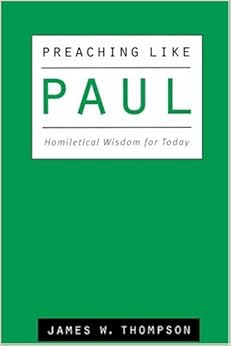
--James W. Thompson, Preaching Like Paul: Homiletical Wisdom for Today, p. 48-49
This line stood out to me perhaps more than all the others:
His proclamation was neither a response to the questions that people were asking nor an attempt to present Christianity as the answer to their own pursuits.
I still remember the first time I heard the idea that faithful and winsome evangelism requires answering the questions people are asking with the truth of God's Word.  I've heard it multiple times, perhaps most recently from Tim Keller:
So the first task of contextualization is to immerse yourself in the questions, hopes, and beliefs of the culture so you can give a biblical, gospel-centered response to its questions.  When Paul began to speak to the philosophers in Athens, he began by saying he had carefully studied their objects of worship (Acts 17:23).  We should do the same.

--Tim Keller, Center Church: Doing Balanced, Gospel-Centered Ministry in Your City, p. 121
Interestingly enough, Keller (commenting on 1 Corinthians 1:22-24) also argues that faithful contextualization requires presenting Christianity as the answer to the pursuits of those who are lost:
Notice that while the gospel offended each culture in somewhat different ways, it also drew people to see Christ and his work in different ways.  Greeks who were saved came to see that the cross was the ultimate wisdom--making it possible for God to be both just and the justifier of those who believe.  And Jews who had been saved came to see that the cross was true power.  It meant that our most powerful enemies--sin, guilt, and death itself--have been defeated.

It is striking, then, to see how Paul applies the gospel to confront and complete each society's baseline cultural narrative.  He does this both negatively and positively.  He confronts each culture for its idols, yet he positively highlights their aspirations and ultimate values.  He uses the cross to challenge the intellectual hubris of the Greeks and the works-righteousness of the Jews.  But he also affirms their most basic collective longings, showing that Christ alone is the true wisdom the Greeks have looked for and is the true righteousness that the Jews have sought.  Paul's approach to culture, then, is neither completely confrontational nor totally affirming.   He does not simply rail against Greek pride in intellect and Jewish pride in power; instead he shows them that the ways they are pursuing these good things are ultimately self-defeating.  He reveals the fatal contradictions and underlying idolatry within their cultures and then points them to the resolution that can only be found in Christ.  This is the basic formula for contextualization.

--Tim Keller, Center Church: Doing Balanced, Gospel-Centered Ministry in Your City, p. 111-112
Now, maybe it's just me, but it doesn't sound to me like Thompson and Keller are painting the same picture of Paul's message and method--nor do they sound complementary.  If this is indeed the case, whose portrait more accurately reflects the biblical landscape?

Thursday, September 04, 2014

God's Military Tactics

So what does God think of militarism?  Does God think, with Hal Lindsey, that the moral downfall of America is due to a "crisis of military weakness"?  Does "the Bible" really "support building a powerful military force" as Wayne Grudem says?  Should we consider a strong national defense to be a biblical virtue?

No.
Not at all.
Quite the opposite, in fact.

However, America's excessive militarism is inconceivable apart from "the support offered by several tens of millions of evangelicals."  This is unbelievable.  Most of all, it's unbiblical.

If America, for instance, used the Bible to shape its warfare policy, that policy would look like this.  Enlistment would be by volunteer only (which it is), and the military would not be funded by taxation.  America would not stockpile superior weapons--no tanks, drones, F-22s, and of course no nuclear weapons--and it would make sure its victories were determined by God's miraculous intervention, not by military might.  Rather than outnumbering the enemy, America would deliberately fight outmanned and under-gunned.  Perhaps soldiers would use muskets, or maybe just swords.  There would be no training, no boot camp, no preparation other than fasting, praying, and singing worship songs.  If America really is the "new Israel," God's holy nation as some believe, then it needs to take its cue from God and His inspired manual for military tactics.  But as it stands, many Christians will be content to cut and paste selected verses that align with America's worldview to give the military some religious backing.  Some call this bad hermeneutics; others call it syncretism.  The Israelite prophets called it idolatry.

--Preston Sprinkle, Fight: A Case for Christian Non-Violence, chapter 3
Ouch.  That stings.  But Amen, brother.

Saturday, August 16, 2014

A Profound and Practical Implication of the Union of Body and Soul

Horder's (the medical chief) notes revealed that perhaps as many as 70 per cent of his private cases could not be classified under recognised medical criteria at all.  'Eats too much', 'Drinks too much' and similar comments, pointed to signs and symptoms with origins normally outside the province of medicine.  Strange though it may sound, it was in a temple of scientific humanism -- Horders' clinic -- that Lloyd-Jones was helped to see the fallacy of the argument that modern man is so different from his forebears that historic Christianity is no longer relevant.  He discovered that man in his fundamental need of a changed relation to God has not changed at all: 'All the changes about which men boast so much are external', he observed. 'They are not changes in man himself, but merely in his mode of activity, in his environment.' The real problem which he now saw written large on Horder's case notes was neither medical nor intellectual.  It was one of moral emptiness and spiritual hollowness.  Horder's card index was to him almost what the vision of a valley of dry bones was to the prophet Ezekiel.

--Iain Murray, The Life of D. Martyn Lloyd-Jones, 1899--1981, p.47-48 (emphasis added)

Tuesday, March 25, 2014

Perhaps Someday Criminal

...a paragraph like this has become highly controversial, even offensive, perhaps someday criminal:

Jesus Christ is coming again to judge the living and the dead (Acts 17:31; Rev. 19:11-21). Those who repent of their sins and believe in Christ (Mark 1:15; Acts 2:38; 17:30) and those who overcome (Rev. 21:7) will live forever in eternal bliss with God in his holy heaven (Rev. 21:1-27) through the atoning work of Christ on the cross (Mark 10:45; Rom. 5:1-21; Cor. 5:21). Those who are not born again (John 3:5), do not believe in Christ (John 3:18), and continue to make practice of sinning (1 John 3:4-10) will face eternal punishment and the just wrath of God in hell (John 3:36; 5:29). Among those who will face the second death in the lake that burns with fire are the cowardly, the faithless, the detestable, the murderers, the sexually immoral, sorcerers, idolaters, and all liars (Rev. 21:8), and among the sins included in the category of sexual immorality is unrepentant sexual intercourse between persons of the same sex (Rom. 1:26-27; 1 Cor. 6:9-10; Jude 5-7). 
Sooner than we realize.  Read the rest here.

Father, please help us to live in the reality that it's not a matter of if this day will come, but when.  And then uphold us by Your mighty right hand, O Lord, that we may stand in that day--whatever the cost.  For Jesus' sake, Amen.

Saturday, January 25, 2014

He Feels the One, He Feels the Other

But here is what I’m wondering. Is the only message we’ll hear and receive the word of justification and acceptance and affirmation? What if our Savior wants to get up in our faces about things in us that displease him? Will we dismiss that message as legalism? We can turn it into legalism. If we respond to the rebukes of Scripture as occasions for self-invented virtue, discounting the finished work of Christ on the cross, then it is legalism. But that is not what the Bible is saying. The Bible is alerting us to the heart of our Father, a heart that is wounded by our sins and follies, a heart that is pleased with our humility and obedience. He feels the one, he feels the other. This is part of the New Covenant message to God’s blood-bought people. Will we receive it?
I'm convinced Ray Ortlund hits the nail on the head of the greatest danger facing true, Reformed, modern evangelicalism with this word.  The reason it's dangerous is because it's so subtle.  Read the rest here.

Saturday, January 18, 2014

Contrary Kingdom

And he gave the apostles, the prophets, the evangelists, the shepherds and teachers, to equip the saints for the work of ministry, for building up the body of Christ, until we all attain to the unity of the faith and of the knowledge of the Son of God, to mature manhood, to the measure of the stature of the fullness of Christ, so that we may no longer be children, tossed to and fro by the waves and carried about by every wind of doctrine, by human cunning, by craftiness in deceitful schemes. Rather, speaking the truth in love, we are to grow up in every way into him who is the head, into Christ, from whom the whole body, joined and held together by every joint with which it is equipped, when each part is working properly, makes the body grow so that it builds itself up in love.
Ephesians 4:11-16
Contrary to the ideals of American heritage in which we focus on the individual, Paul begins by focusing on the community and on our corporate life together (4:1-16). Then, and only then, from 4:17 onwards, does he deal with day-to-day life as individuals. Even then, he is concerned largely with relationships. Individualism runs strong in Western culture and the American dream. We exalt the individual who can rise from circumstances of great deprivation or poverty and excel in sports, education, or acting, to become a national idol or even the president. There is, however, a strong emphasis in this text, as well as elsewhere in the Scriptures, on our belonging to a community and on our corporate role and responsibilities before considering our role as individuals.

--Stephen J. Wellum and Peter J. Gentry, Kingdom through Covenant

Tuesday, January 14, 2014

The Newness of the New Covenant

In those days they shall no longer say: ‘The fathers have eaten sour grapes, and the children's teeth are set on edge.’ But everyone shall die for his own iniquity. Each man who eats sour grapes, his teeth shall be set on edge. Behold, the days are coming, declares the Lord, when I will make pa new covenant with the house of Israel and the house of Judah... And no longer shall each one teach his neighbor and each his brother, saying, ‘Know the Lord,’ for they shall all know me, from the least of them to the greatest, declares the Lord. For I will forgive their iniquity, and I will remember their sin no more.
Jeremiah 31:29-31, 34
What verse 34 is saying...in contrast to verses 29-30, is that in the old covenant, people became members of the covenant community simply by being born into that community.  As they grew up, some became believers in Yahweh and others did not.  This resulted in a situation within the covenant community where some members could urge others members to know the Lord.  In the new covenant community, however, one does not become a member by physical birth but rather by new birth, which requires faith on the part of every person.  Thus only believers are members of the new community: all members are believers, and only believers are members.  Therefore in the new covenant community there will no longer be a situation where some members urge other members to know the Lord.  There will be no such thing as an unregenerate member of the new covenant community.  All are believers, all know the Lord, because all have experienced the forgiveness of sins.  What Jeremiah is teaching in 31:33-34 is identical to what Isaiah is teaching in Isaiah 54:13: "all our children shall be taught by the LORD, and great shall be the peace of your children" (ESV).  Everyone in the covenant community will experience reconciliation (peace) with God, and so everyone will have a living relationship with the Lord, and so the divine instruction for living will be written upon the heart.

--Stephen J. Wellum and Peter J. Gentry, Kingdom through Covenant

Monday, January 06, 2014

Avoid Both Ditches

Is anyone among you suffering? Let him pray. Is anyone cheerful? Let him sing praise. Is anyone among you sick? Let him call for the elders of the church, and let them pray over him, anointing him with oil in the name of the Lord. And the prayer of faith will save the one who is sick, and the Lord will raise him up. And if he has committed sins, he will be forgiven.
James 5:13-15
Whenever we interpret Scripture and/or do theology, we must always be aware of the danger of the two ditches.  The task of interpreting Scripture and theologizing is like walking a narrow path with a ditch both on your right and on your left.  And neither ditch is safer than the other.  The end result of falling into either ditch--if you remain there--is death.  It's that serious.  Looking at the text above as an example, let's consider two ditches (in no particular order) we must avoid at all costs while doing the work of interpretation and application.

Ditch #1

The most conservative scholars assert that the text above has nothing to do with physical sickness and healing.  John MacArthur is perhaps the most well-known proponent of this position.  His essential argument is that when we look at the context in which the book of James was written, it was written to believers during a time when they were experiencing intense opposition and persecution for their faith.  And, over the course of time, such intense opposition has a way of wearing down a believer to the point where he/she becomes spiritually weak.  MacArthur shows that the words that have been translated as "sick" are often used elsewhere in Scripture to refer to spiritual sickness or weakness.  So what James is saying is that believers who become so worn down by persecution that they find themselves spiritually weak can look to the leaders of the church to pray for them so that their spiritual vitality might be restored.

I must be honest.  That's a very attractive interpretation to me.  And I have so much respect and admiration for MacArthur as a steward of Scripture.  But upon closer examination, I just can't figure out what to do--according to that interpretation--with the second half of verse 15: And if he has committed sins, he will be forgiven.

If this text is primarily about those who are suffering because they are being sinned against at the hands of insolent persecutors, then why in the world is James suggesting that the people who are suffering are themselves the ones who might have committed sin?  That seems totally out of place based on the suggested context.

The existence of the second half of verse 15 seems to imply that the sickness of a Christian either could be related to his/her sin or it could have nothing to do with his/her sin.  We see an example of the former in 1 Corinthians 11:27-30.  We see an example of the latter in John 9:1-3.

This renders the entirely spiritual reading of the text above--at least from my perspective--very suspicious and unconvincing if we take the whole into account.

Ditch #2

Those who embrace prosperity theology will very easily camp out on the first half of verse 15: And the prayer of faith will save the one who is sick, and the Lord will raise him up.

"See," they say, "the word of God tells us that when we pray in faith, those who are physically sick will be healed.  So, if you are physically sick and you aren't healed by prayer, you or those who are praying for you don't have enough faith.  You just need more faith."  And in the worst forms of this kind of theologizing, believers can very easily be manipulated by wolves in sheep's clothing to do whatever they're told as a way of proving the strength of their faith.

But we must understand the type of literature that the book of James belongs to.  James falls under the genre of wisdom literature, like the Proverbs.  And the words of wisdom literature aren't to be taken as truth without exception.  They're truths that often stand as a general rule as proven by observation of the world we live in, but aren't without exception, especially in the era of the new covenant where Jesus has inaugurated a seemingly upside-down kingdom.  For example, consider the following proverb:
The Lord does not let the righteous go hungry, but he thwarts the craving of the wicked.
Proverbs 10:3
But what are we to make of the apostle Paul who multiple times makes mention of hunger and thirst (1 Corinthians 4:11, 2 Corinthians 11:27, Romans 8:35, Philippians 4:12) as though they were frequent trials he faced?  Must Paul, therefore, be unrighteous if he's experiencing hunger?  Of course not!  The will of God isn't that simple.  It's deeply complex.

The existence of the first half of verse 15 seems to imply that God means for us to pray in faith for physical healing when believers are sick.  But prayers of the greatest faith oftentimes won't result in healing, for reasons that God might sometimes reveal (2 Corinthians 12:7-10)--and sometimes not.

Conclusion

So how do we understand the text above without falling into the ditch on either side?  There's no doubt the text is talking about the physical sickness of believers.  Sometimes that sickness is the result of sin, but sometimes it's not.  And we should pray in faith for God to heal the believer who is sick.  But we must do so always humbly submitting ourselves to the sovereign God of all wisdom who on this side of eternity sometimes chooses not to heal because He has greater purposes to accomplish by withholding healing than by granting it--whether He clearly reveals those purposes to us or not.

The ditches abound in Christianity.  Whether it's the sovereignty of God vs. the responsibility of man, the continuation of spiritual gifts vs. the cessation of spiritual gifts, the deity of Jesus vs. His humanity, justification vs. sanctification, God's desire for all people to be saved vs. His election of only some to salvation, the already of the kingdom of God vs. the not yet, each of these and many more debates throughout church history has revealed the practical consequences in daily life of focusing on one truth to the exclusion of another.  But, as J.I Packer says, "a half-truth masquerading as the whole truth becomes a complete untruth."

Almost every step we take as we navigate the world of interpreting and applying Scripture, we're in danger of falling into a ditch on one side or the other.  May the Holy Spirit help us to see and avoid both ditches.

Note: I'm indebted to the work of Nathan Wells for much of the development of my thought behind this post.

Friday, January 03, 2014

The End for Which God Created the World

Then God said, “Let us make man in our image, after our likeness. And let them have dominion over the fish of the sea and over the birds of the heavens and over the livestock and over all the earth and over every creeping thing that creeps on the earth.” So God created man in his own image, in the image of God he created him; male and female he created them. And God blessed them. And God said to them, “Be fruitful and multiply and fill the earth and subdue it, and have dominion over the fish of the sea and over the birds of the heavens and over every living thing that moves on the earth.” And God said, “Behold, I have given you every plant yielding seed that is on the face of all the earth, and every tree with seed in its fruit. You shall have them for food. And to every beast of the earth and to every bird of the heavens and to everything that creeps on the earth, everything that has the breath of life, I have given every green plant for food.” And it was so. And God saw everything that he had made, and behold, it was very good. And there was evening and there was morning, the sixth day.
Genesis 1:26-31
Given the normal meanings of "image" and "likeness" in the cultural and linguistic setting of the Old Testament and the ancient Near East, "likeness" specifies a relationship between God and humans such that man can be described as the son of God, and "image" describes a relationship between God and humans such that man can be described as a servant king. Although both terms specify the divine-human relationship, the first focuses on the human in relation to God (likeness) and the second focuses on the human in relation to the world (image). These would be understood to be relationships characterized by faithfulness and loyal love, obedience and trust--exactly the character of relationships specified by covenants after the Fall. In this sense the divine image entails a covenant relationship between God and humans on the one hand, and between humans and the world on the other.
--Stephen J. Wellum and Peter J. Gentry, Kingdom through Covenant
This paragraph is the most important commentary I have ever read concerning Genesis 1.  The implications, to me, are staggering for how we understand the rest of the Bible.

The idea that humans being created in the "image" of God is associated with human relationship to the world and after the "likeness" of God being associated with human relationship to God makes so much sense of the text, especially when Genesis 1 is compared with Genesis 5.  I can't remember the last time I had such a profound "aha!" moment meditating on Scripture.

In Genesis 1, the text states that humans are both created in God's image and after his likeness, but image has the preeminence based on word order (Genesis 1:26) as well as emphasis and repetition (Genesis 1:27).

In Genesis 5, the text states that Adam fathered a son both in his image and after his likeness, but this time likeness has the preeminence based on word order (Genesis 5:3) as well as emphasis (Genesis 5:1).

Why these different emphases?  In Genesis 1, image is the focus because the author wants to highlight human dominion over creation as the main theme of the end of the chapter.  In Genesis 5, likeness is the focus because the author wants to highlight the father/son relationship as the theme of chapter.

So, as I finished reading Genesis 1, I found myself asking this question: Why does God reveal that aspect of human identity as one who represents Him (image) prior to that aspect of human identity as one who is in relationship with Him (likeness)?

At this point, here's my best answer: Because the chief end of God in creation isn't so much to enter relationship with man as it is to manifest His majesty, power, and authority.  Thus when God sees that His creation is very good in verse 31, it's not so much because of man in and of himself as it is that God's majesty, power, and authority are now manifested in creation through man in a way that they hadn't been prior to that point in creation.

I feel humbled to the dust reflecting on the centrality of God and the relative insignificance of me.

Thursday, January 02, 2014

In All That He Does, He Prospers?

He is like a tree planted by streams of water that yields its fruit in its season, and its leaf does not wither. In all that he does, he prospers.
Psalm 1:3
"In all that he does, he prospers."

Really?

Though prosperity doesn't mean exactly the same thing for every person, there isn't a human being alive who doesn't want to prosper in everything he does.

When we think about prospering in all that we do, it usually comes with a "right here, right now" kind of mentality.  For example, in the context of sales, the ideal way that someone would prosper in all that he does would be to make a sale every time he makes a pitch, starting with today.  This mentality has no room for struggle of any kind.

But when you take a step back and look at Psalm 1, the psalmist's idea of what it means to prosper in this context is entirely different from this "right here, right now" understanding of what it means to prosper.

Just looking at verse 3 by itself, the agricultural imagery in and of itself is diametrically opposed to a "right here, right now" understanding of what it means to prosper.  Crops don't bear fruit in every season.  They yield fruit in due season.

Verses 5-6 point us forward to the day of judgment, the day of reckoning when God Himself will dispense the ultimate consequences for those who chose not to walk in the narrow path.  And just like the wicked don't experience full judgment for their rebellion right here, right now (Psalm 92:6-7), the righteous don't experience the full reward of their trust in God right here, right now (Psalm 73:23-26, Habakkuk 3:17-19).

So when the psalmist tells us that the righteous prospers in all that he does, the very "right here, right now" mentality that we're so tempted toward when we hear that is the very thing that he's inviting us to reject--the mentality that presides in the counsel of the wicked, motivating them to do all that they do (Proverbs 1:11-14).

Rather, the psalmist is inviting us into a process.  Just like farming, it's a process that often appears pointless.  It's a process that often feels tedious.  It's a process that requires great patience.  But it's a process that is always effective when we persist in it even though much of its benefit is invisible to us.
...but his delight is in the law of the Lord, and on his law he meditates day and night.
Psalm 1:2
This is the process the Holy Spirit--through the psalmist--invites us to.  To delight in God's Word and to meditate on it day and night.  None of us will ever do this perfectly in this life, which is part of the reason we often don't feel like we're prospering in all that we do (Psalm 119:65).

But the more that God, by His grace, deepens our delight in His Word and our continual meditation on and application of it to our lives, the more the lens with which we view our lives is one in which everything we do right here, right now is an investment in our future hope.  Everything we experience right here, right now--especially the negative--"is preparing for us an eternal weight of glory beyond all comparison" (2 Corinthians 4:17).  And the more we believe this deep down in our bones, the more we identify with the end of verse 3: "In all that he does, he prospers."

Really.

Father, please grant us the grace to press forward in the process as we begin 2014.  And remind us when we lose sight this year not only that there are many days in a year but that, by Your grace, there are many years in a lifetime.  In Jesus' name, Amen.

Wednesday, January 01, 2014

A Future Tense Application of the Gospel

One way to apply the gospel to our giving is to look at the cross and see how generous and sacrificial God was in giving Jesus up for us and to look long enough so that the Holy Spirit transforms us by what we see in that gift to make us more generous and sacrificial with our finances.

That's one way we can apply the gospel to our giving. Let's call that a past tense application of the gospel. We are looking back at the good news of what Jesus did 2,000 years ago to apply that to our giving.

I want to suggest another way we can apply the gospel to our giving. Let's call this a future tense application of the gospel. In this case, we're looking forward to the good news of what Jesus will one day do to apply that to our giving.
Do not lay up for yourselves treasures on earth, where moth and rust destroy and where thieves break in and steal, but lay up for yourselves treasures in heaven, where neither moth nor rust destroys and where thieves do not break in and steal. For where your treasure is, there your heart will be also.
Matthew 6:19-21
One of the reasons it's challenging to give sacrificially and generously of our finances is because the more we give, the less treasure we have to store up for ourselves. And storing up treasure is something that we're all hard-wired to do in some way, shape, or form. The question isn't whether we store up treasure, the question is where do we store it?

But Jesus doesn't tell us not to store up treasure. He tells us to store it where it's going to last and bring us the most joy. He tells us to store up treasure where it's going to give us the most possible bang for our buck. And that's not by investing money anywhere here on earth. It's by investing money in heaven, which is what we do when we give generously and sacrificially to the work of the kingdom. But here's the catch: what we store in heaven we can't touch until the future. It's not simply a long-term investment; it's the longest-term possible investment.  There's no stock or 401k plan that can match this investment strategy!

You see, Jesus doesn't just motivate us to give by pointing us backward to what He did for us 2,000 years ago on the cross. He motivates us to give by pointing us forward to what He will do for us in the future. He's going to reward us in heaven (He talks about this idea of a future reward all over the Sermon on the Mount).

And the reason this is an application of the gospel is because:

1) God is going to be the One who rewards us. He's calling us to trust in what He will one day do, not in what we do.

2) The only reason any of us is going to be in heaven is because of what Jesus has already done by dying to atone for our sins on the cross 2,000 years ago.

So as we reflect on the why of giving, may we be a people who not only look back to the good news of what Jesus has done for us; but may our giving also be empowered by the good news of what Jesus will one day do for us because He's promised to. And He who promised is faithful.

Monday, December 30, 2013

Jesus Died for ... You?

Over the last few years, I've held to an understanding of the atonement of Christ known as "sufficient for all, efficient for some." In other words, my answer to the question, "Did Jesus die for every human being or only those who God chose for salvation before the foundation of the world?" is "Yes."

Yes, Scripture teaches that Jesus died for the elect in such a way that not only makes our salvation possible, but secures it.

But I believe Scripture also teaches that Jesus died for every human being in such a way that makes salvation possible for every human being (e.g. Hebrews 2:9).  Therefore, we really can tell non-believers, "Jesus died for you", and mean it with all our hearts.  Even though many people will reject Jesus all the way to hell, it's as though He hung on the cross with arms wide open, offering Himself to any who would turn to Him and inviting any who would come.   And it's this rejection of the greatest possible gift that was fully paid for and freely offered to all that will make God's enemies most worthy of final judgment.

While discussing this with a friend of mine, he asked me "Does anyone in the Bible tell an unbeliever that 'Jesus died for them'?"  And that question really got me to thinking.

The one place in the New Testament where we have sermons recorded which were being addressed primarily, if not exclusively, to non-believers is the book of Acts.  So I began to read the book of Acts with that question in mind.

I didn't expect what I would find when I got to chapter 3.
And now, brothers, I know that you acted in ignorance, as did also your rulers. But what God foretold by the mouth of all the prophets, that his Christ would suffer, he thus fulfilled. Repent therefore, and turn back, that your sins may be blotted out, that times of refreshing may come from the presence of the Lord, and that he may send the Christ appointed for you, Jesus, whom heaven must receive until the time for restoring all the things about which God spoke by the mouth of his holy prophets long ago.
Acts 3:17-21 (
emphasis added)
Notice a couple things here.

First, Peter mentions that God foretold by the mouth of the prophets that Jesus would suffer and He fulfilled it (verse 18). He's most likely referring to passages like Isaiah 53. But, even if not, the point he's making is that through the life, death, and resurrection of Jesus, God fulfilled what He had spoken by the mouth of the prophets.

Second, notice that Peter says that this Christ is appointed for "you" (verse 20).  You? That can only mean his non-believing hearers. Appointed? Christ is just another word for Messiah, which was an office that Jesus fulfilled. And all throughout the whole Old Testament the main role of Messiah was to save His people from their sins through His life, death, and resurrection.

In other words, Peter is saying to his non-believing hearers, "Jesus is the one who was appointed to suffer on the cross and rise from the dead for you and thus save you from your sins".  And Acts 4:4 tells us that many--not all--who heard this message believed.  There were some who heard Peter say "Christ was appointed to suffer for you" who walked away and did not believe.

When we tell a non-believer "Jesus died for you", is that not to do the same thing Peter did when he told his non-believing hearers that Christ was appointed to suffer for them?

One could argue that Jesus was appointed for the nation of Israel as a corporate whole, but not for every individual within the nation.  True.  But that doesn't change the fact that there were some individuals within that group who heard Peter who were a part of the nation of Israel and yet didn't believe.  If we hold that Jesus was appointed to die for the nation of Israel as a corporate whole, then using John 3:16 for example, we could also say that Jesus was sent to die for the world as a corporate whole, even though we know that many people in the world will never believe in Him.  And in the same way that Peter could tell his hearers who identified with corporate Israel that Christ was appointed for them even though many would still persist in unbelief, today we can tell our hearers who identify with the world that Jesus died for them even though many will still persist in unbelief.

I can't improve upon the way D.A. Carson summarizes this biblical conviction concerning the atonement:
I argue, then, that both Arminians and Calvinists should rightly affirm that Christ died for all, in the sense that Christ's death was sufficient for all and that Scripture portrays God as inviting, commanding, and desiring the salvation of all, out of love. Further, all Christians ought also to confess that, in a slightly different sense, Christ Jesus, in the intent of God, died effectively for the elect alone, in line with the way the Bible speaks of God's special selecting love for the elect.

--D.A. Carson, The Difficult Doctrine of the Love of God
For further study on this position of the atonement--including key biblical texts to wrestle with--consider Bruce Ware's essay outline on the atonement arguing for what he calls the "Multiple Intentions" view.

Friday, December 27, 2013

The Christian's Calling: A Life of Unfair Treatment

Servants, be subject to your masters with all respect, not only to the good and gentle but also to the unjust. For this is a gracious thing, when, mindful of God, one endures sorrows while suffering unjustly. For what credit is it if, when you sin and are beaten for it, you endure? But if when you do good and suffer for it you endure, this is a gracious thing in the sight of God. For to this you have been called, because Christ also suffered for you, leaving you an example, so that you might follow in his steps. He committed no sin, neither was deceit found in his mouth. When he was reviled, he did not revile in return; when he suffered, he did not threaten, but continued entrusting himself to him who judges justly.
1 Peter 2:18-23
Addressing the believers he's writing to, Peter begins verse 21 with the words "For to this you have been called." It's important for us to understand exactly what Peter is saying because he's describing not just what his 1st century readers were called to, but what all Christians are called to--by necessity.

So what is the this that Christians have been called to?

The preposition "for" that begins verse 21 functions as a ground for why Peter has written what he has just written in the previous verses.  And what is the essential exhortation of the previous verses?
Verse 18: Servants, be subject to your masters with all respect, not only to the good and gentle but also to the unjust.
The main exhortation here isn't simply for servants to be subject to masters in general, but for servants to respond well to masters who treat them unfairly.  How do we know that how we respond in the midst of unfair treatment is the main thrust of Peter's exhortation?  Because everything he writes after verse 18 highlights the context of being treated unfairly.
Verse 19: For this is a gracious thing, when, mindful of God, one endures sorrows while suffering unjustly (unfair treatment).
Verse 20:  For what credit is it if, when you sin and are beaten for it (fair treatment), you endure?  But if when you do good and suffer for it you endure (unfair treatment), this is a gracious thing in the sight of God.
And then, finally, Peter points us to the ultimate example--indeed the only example--of One who responded well to unfair treatment.
Verses 21-23:  For to this you have been called (responding well when treated unfairly), because Christ also suffered for you (was treated unfairly by men), leaving you an example, so that you might follow in his steps (of responding well when treated unfairly by men).  He committed no sin, neither was deceit found in his mouth.  When he was reviled, he did not revile in return; when he suffered, he did not threaten, but continued entrusting himself to him who judges justly.
Over the last week (and in some ways the last year), I've been thinking about how easy it is and, in a sense, how natural it is for one person to be misunderstood by another.  It's so easy to have the best intentions (from my perspective) and yet for others to misinterpret those intentions in a negative way.

And it's usually--though not always--when my good intentions are misunderstood that I end up on the receiving end of what feels like unfair treatment.  In my experience, there's a direct relationship between how good I feel like my intentions are to how unfairly I feel like I'm being treated when those intentions are misunderstood.

And you know what?  In those moments where my good intentions are misunderstood and I end up feeling treated unfairly, everything that Jesus didn't do on the cross is what I end up doing in those moments.  In those moments, contrary to the description of the Suffering Servant in verses 21-23,  I commit sin, I--in instinctive self-defense--speak words that purposely obscure at least some portion of reality, my heart reviles, my heart threatens, and I want to exact justice for myself rather than entrusting myself to the Father who judges justly.

How is Jesus different?  At least two ways, both of which I've already hinted at.

First, though I respond poorly when treated unfairly by men, Jesus responds well when treated unfairly by men.  The phrase "by men" is important because, in one sense, Jesus was not treated unfairly on the cross.  The cross was the greatest display of justice when the Father, to vindicate His righteousness, placed upon the sin-bearer the penalty that sin rightly deserved (Romans 3:21-26).  Jesus, as that sin-bearer, was not treated unfairly on the cross by the Father.  But He was treated unfairly by the men who sentenced him to the cross, which seems to be the focus of Peter's thought, especially when he ends verse 23 by saying that, in spite of the unfair treatment by men, Jesus nonetheless entrusted Himself to the God who judges justly--or, with fairness.

Second, Jesus always has the best and purest intentions.  In this life, my intentions are always mixed and never completely pure.  What this means is that there is always legitimate reason for others to misunderstand me.  But that is never the case for Jesus.  There is never legitimate reason to misunderstand Him.  So if anyone should tolerate being misunderstood, it's me; not Jesus.

But what's so amazing is that the One who has no reason to be misunderstood by men is the only one who is patient when misunderstood by men and in a sense understands us when we misunderstand Him (Luke 23:34).

And He calls us to imitate Him in this very thing--this naturally impossible thing.  Not just toward the non-Christian who mocks you, but toward the dear brother who misinterprets your loving intention.  The reason why Peter twice calls it a gracious thing (verse 19, 20) to respond like Jesus when we feel treated unfairly by men is precisely because it's an impossible thing.  If it were easy or even possible, it wouldn't require the supernatural power of grace.

But, Christian, this is our calling.  This is our life.

Father, please grant us more grace.  In the name of the Suffering Servant we pray, Amen.

Thursday, December 26, 2013

Riches and Wealth: The Heart of the Matter

In that night God appeared to Solomon, and said to him, “Ask what I shall give you.” And Solomon said to God, “You have shown great and steadfast love to David my father, and have made me king in his place. O Lord God, let your word to David my father be now fulfilled, for you have made me king over a people as numerous as the dust of the earth. Give me now wisdom and knowledge to go out and come in before this people, for who can govern this people of yours, which is so great?” God answered Solomon, “Because this was in your heart, and you have not asked for possessions, wealth, honor, or the life of those who hate you, and have not even asked for long life, but have asked for wisdom and knowledge for yourself that you may govern my people over whom I have made you king, wisdom and knowledge are granted to you. I will also give you riches, possessions, and honor, such as none of the kings had who were before you, and none after you shall have the like.”
2 Chronicles 1:7-12
Three observations and two implications.

Observation #1:  Solomon does not ask God to give him possessions, wealth, honor, revenge, or long life for himself (verse 11).

Obersvation #2:  God is pleased not only that Solomon asks for wisdom ("Because ... [you] have asked for wisdom..."), but also that Solomon does not ask for riches, possessions, and honor ("Because ... you have not asked for possessions, wealth, honor...").

Observation #3:  God grants Solomon immeasurably abundant riches, possessions, and honor (verse 12).

Implication #1:  Riches, possessions, and honor are not inherently bad.  If they were, God would never give them to Solomon.  The Father only gives good gifts to His children (Matthew 7:9-11).

Implication #2:  That doesn't give us the green light to ask God for riches, possessions, and honor--or even to want these things.  We must be very careful here.  Just because a thing isn't inherently evil doesn't mean we should want or pursue that thing.  The issue at stake is the heart.  What was Solomon's heart in asking for wisdom?  God reveals this in His response to Solomon: "Because this was in your heart... you have asked for wisdom and knowledge for yourself that you may govern my people."  Wisdom not just for himself.  But for himself in order that he might serve others and establish God's kingdom.  That's a healthy heart.  And when the heart is right--which God alone (and not even us) can see--God very often will give us riches, possessions, and honor.  But that does not mean we should pursue these things.  Ours is only to be faithful in seeking His kingdom and to let God distribute the increase as He sees fit (Matthew 6:33).  In other words, we let the chips fall where they will.  We have no right or claim to anything.

The heart by nature is deceitful (Jeremiah 17:9).  Even after God regenerates an individual and gives him or her a new heart, there are still remnants of corruption that allow our hearts to deceive us (Galatians 5:17).  And one of the ways the heart deceives is by inciting us to pursue things that are good for the wrong reasons--namely, self-centered reasons rather than God-centered and others-centered reasons (James 4:3-4).  And the heart is more deceitful than we think.  It will even go so far as to suggest that the riches we desire can be used to bless others in order to justify our pursuit of them since we could never justify it for our own ends alone.  "See," it tells us, "this really is about others."  No, it's self using others as a means to my own selfish ends.  Which is even more sinful than my selfishness in the first place.

So, could one argue that since riches aren't inherently evil, there's nothing wrong with desiring to be wealthy and asking God to bless that endeavor?  Well, based on logic alone, sure.  But we have a higher authority than logic--namely, Scripture.  And the predominant testimony of Scripture--specifically with regard to money--seems to be that a heart that desires riches and wealth is where the defect lies (1 Timothy 6:9-10, Proverbs 23:4-5, Proverbs 30:8-9), not in the riches and wealth itself.

So be very careful.  Passages like this and many others in Scripture--if the Holy Spirit gives us eyes to see--provide for us penetrating insight into the heart of God for the purpose that we might really know Him--the only true and living God--and, in knowing Him, know what pleases Him.

Wednesday, December 25, 2013

The True Nature of Christianity

From Christ Is Deeper Still:
“A saying of Chrysostom’s has always pleased me very much, that the foundation of our philosophy is humility.  But that of Augustine pleases me even more: ‘. . . so if you ask me concerning the precepts of the Christian religion, first, second and third, and always I would answer ‘Humility.’”

John Calvin, Institutes, 2.2.11.

“Another observation, in a former letter of yours, has not escaped my remembrance – the three lessons which a minister has to learn:  1. Humility.  2. Humility.  3. Humility.  How long are we learning the true nature of Christianity!”

Charles Simeon, quoted in Charles Simeon, by H. C. G. Moule (London, 1956), page 65.

“According to Christian teachers, the essential vice, the utmost evil, is Pride.  Unchastity, anger, greed, drunkenness, and all that, are mere fleabites in comparison.  It was through Pride that the devil became the devil.  Pride leads to every other vice.  It is the complete anti-God state of mind.”

C. S. Lewis, Mere Christianity (New York, 1958), page 94.
From the apostle Paul:
Do nothing from selfish ambition or conceit, but in humility count others more significant than yourselves. Let each of you look not only to his own interests, but also to the interests of others. Have this mind among yourselves, which is yours in Christ Jesus, who, though he was in the form of God, did not count equality with God a thing to be grasped, but emptied himself, by taking the form of a servant, being born in the likeness of men. And being found in human form, he humbled himself by becoming obedient to the point of death, even death on a cross. Therefore God has highly exalted him and bestowed on him the name that is above every name, so that at the name of Jesus every knee should bow, in heaven and on earth and under the earth, and every tongue confess that Jesus Christ is Lord, to the glory of God the Father.
Philippians 2:3-11
After exhorting us to humility (v.3-4), Paul shows us what it means to have a humble mind and heart by pointing us to the incarnation of Jesus (v.5-11). In other words, in the mind of the apostle, humility doesn’t exist apart from the person and work of Jesus (“which is yours in Christ Jesus”–and only in Him). Jesus Himself is the definition of humility. And, in this sense, humility really is the true nature of Christianity.

Merry Christmas!